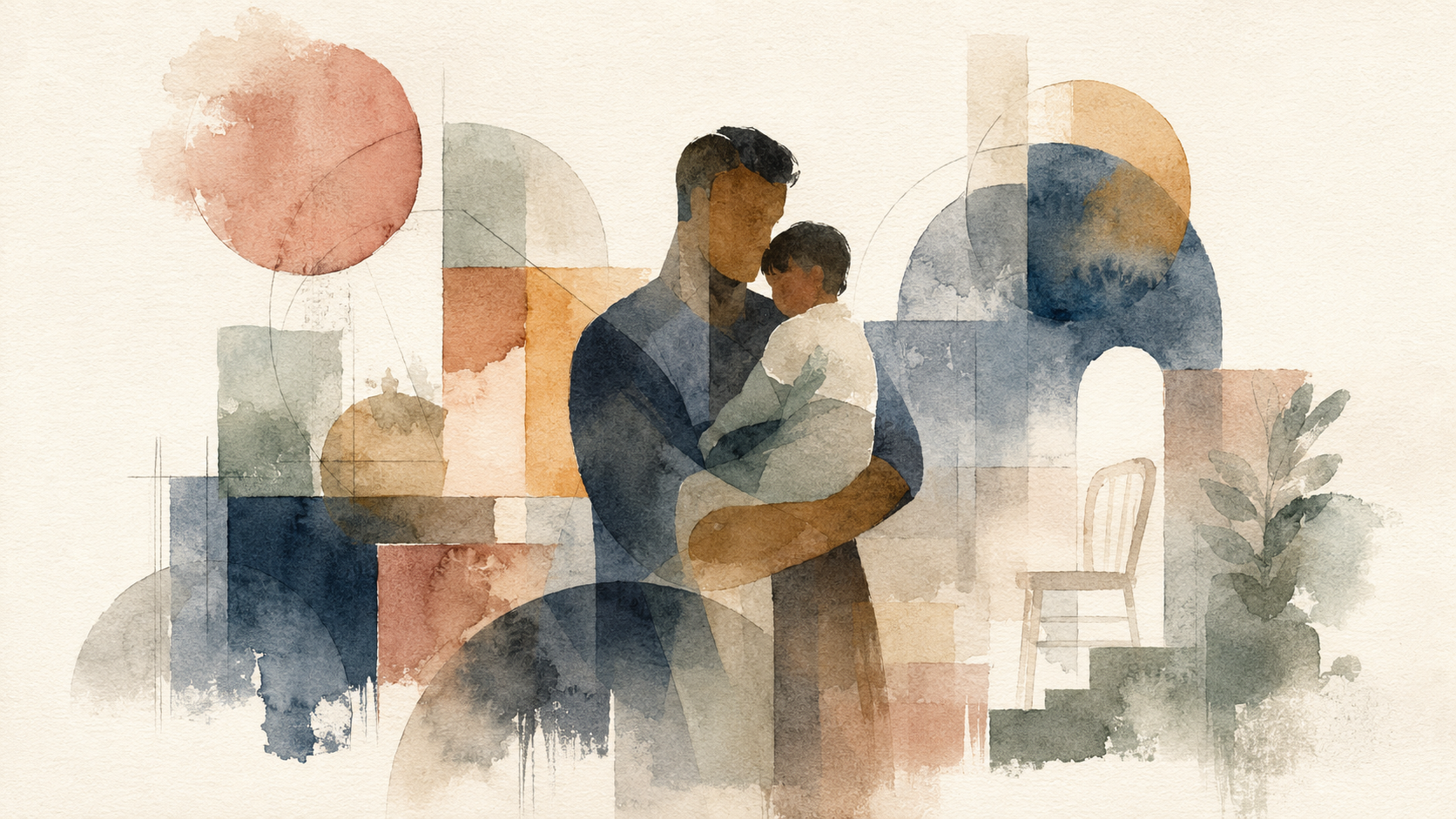
If you are a single father reading this at 11 p.m. after finally getting the kids to bed, with a sink full of dishes behind you and an inbox full of work ahead of you, I want to start by saying something you may not hear often enough: what you are carrying is real, it is heavy, and running on empty is not a character flaw. It is a predictable response to an unsustainable load.
In my practice, I work with individuals and couples across a range of life circumstances, and single fathers are one of the groups I see quietly struggling the most. They rarely walk in and say, “I think I’m burned out.” Instead, they say things like, “I’m just tired all the time,” or “I snap at my kids over nothing and then feel terrible,” or “I used to enjoy this and now I’m just getting through the day.” Those are the fingerprints of burnout. And once you learn to recognize them, you can do something about them.
This article is a deep, honest look at single father burnout: what it actually is, why fathers are uniquely vulnerable to it, the signs that you are running on empty, the patterns I see again and again in the therapy room, and what genuinely helps. My goal is not to add one more thing to your to-do list. It is to help you understand what is happening inside you so the next step feels possible instead of overwhelming.
What Single Father Burnout Actually Is
Burnout is not just being tired. Researchers who study parental burnout specifically describe it as a distinct syndrome with three core features: an overwhelming exhaustion related to your role as a parent, an emotional distancing from your children, and a growing sense that you are no longer an effective or “good” parent (Frontiers in Psychology / Mikolajczak & Roskam). What makes it so painful is that these feelings stand in sharp contrast to how you used to feel. The dad who once looked forward to weekends with his kids now dreads them. The father who prided himself on patience now runs out of it by 8 a.m.
The leading framework for understanding this comes from psychologists Isabelle Roskam and Moïra Mikolajczak, who describe parental burnout as the result of a chronic imbalance between demands and resources. In their words, burnout develops “when parental resources are insufficient to meet the demands (whatever they are)” (Frontiers in Psychology). Read that again, because it matters enormously for single fathers: it is not about how “hard” your kids are or whether you are “tough enough.” It is about the ratio between what is being asked of you and what you have available to give. When you are parenting solo, that ratio is structurally tilted against you. There is no second adult to tag in at bath time, no one to take the night shift when a child is sick, and often no one to simply say, “I’ve got this, go rest.”
This is also why parental burnout is not the same as ordinary work stress or even clinical depression, though they can overlap. In studies involving thousands of parents, parental burnout, job burnout, and depression loaded onto separate factors and had distinct consequences (UCLouvain research repository). You can love your job, feel fine about your career, and still be completely burned out as a parent. That distinction is important, because it means the fix is not simply “take a vacation from work.”
Why Single Fathers Are Especially Vulnerable
Parenting stress is a national problem, not a personal failing. In 2024, the U.S. Surgeon General took the unusual step of issuing a formal public health advisory on the mental health and well-being of parents, reporting that 33% of parents experienced high levels of stress in the past month compared to 20% of other adults, and that 48% said that on most days their stress is completely overwhelming, versus 26% of non-parents (U.S. Department of Health and Human Services). When the nation’s top doctor declares parental stress a public health issue, it is a signal that the pressure you feel is not imagined.
But single fathers face an intensified version of this. There are roughly 2 to 3 million single-father households in the United States, and while single fathers are outnumbered by single mothers, they often carry an under-recognized burden precisely because the cultural image of a “single parent” is almost always a mother. That invisibility has real consequences. In one of the few studies to examine lone fathers directly, researchers found that lone fathers were nearly four times more likely to experience a common mental disorder than partnered men (PubMed / National Psychiatric Morbidity Survey). The drivers were financial strain and, critically, a lack of social support.
That lack of support is the piece I want to dwell on, because it shows up in almost every session I have with single dads. The Surgeon General’s advisory notes that loneliness and isolation are among the defining stressors for modern parents, and the data on single parents specifically is stark: the former Surgeon General reported that about 65% of parents report loneliness, including over 75% of single parents (PBS NewsHour interview with Dr. Vivek Murthy). For fathers, this collides with a broader trend researchers have called a “friendship recession.” The share of men with at least six close friends fell from 55% in 1990 to 27%, and the share of men with no close friends at all rose fivefold, from 3% to 15% (American Enterprise Institute). Now imagine being one of those men and also being the only adult responsible for one or more children. The support that might otherwise buffer stress simply is not there.
Then there is the help-seeking gap. Men are consistently less likely than women to seek professional support for their mental health, and a large meta-analysis found that stronger endorsement of traditional masculine norms is significantly associated with more negative attitudes toward seeking help and higher self-stigma about it (PubMed meta-analysis on masculinity and help-seeking). In the therapy room, this often sounds like, “I should be able to handle this on my own,” or “Other people have it worse.” Many single fathers were raised to equate being a good man with being self-sufficient and uncomplaining. That belief, however well-intentioned, becomes a trap: it keeps the very people who most need support from reaching for it.
The Signs You’re Running on Empty
Burnout rarely announces itself. It creeps in. Below are the signs I watch for in my work with fathers, organized around the three dimensions researchers have identified, plus the physical and relational ripples that follow.
1. Bone-deep emotional exhaustion
This is the heart of burnout. In the language clinicians use, high emotional exhaustion means you feel “used up” and as if you have nothing left to give, often accompanied by fatigue, headaches, and sleep disturbances (Maslach Burnout framework overview). For single fathers, it is the feeling of dread when you wake up and remember everything the day requires before your feet even hit the floor. It is not the tiredness that a good night’s sleep fixes, because there rarely is a full night’s sleep. You are emotionally drained by the parental role to the point that thinking about it makes you feel you have reached the end of your rope.
2. Emotional distancing from your kids
This one carries the most shame, and it is the one fathers are most reluctant to name. Parental burnout research describes it as becoming emotionally distant from your children: you keep taking care of them, but on autopilot, meeting the functional needs while the warmth quietly drains out (Frontiers in Psychology). You get through homework and dinner and bedtime, but you are not really there. Dads describe it as feeling like a manager of a household rather than a parent to a child. If you have caught yourself going through the motions with a kid you love deeply and wondered what is wrong with you, please hear me: this is a well-documented symptom of burnout, not evidence that you are a bad father.
3. A collapsing sense of parental accomplishment
The third dimension is a loss of fulfillment, the sense that you cannot stand your role anymore and no longer enjoy being with your children (Frontiers in Psychology). You may find yourself constantly comparing your parenting to an impossible standard, feeling like you are failing no matter how much you do. The Surgeon General’s advisory specifically flags a “culture of comparison,” often amplified by social media, that leaves parents feeling perpetually behind (U.S. Department of Health and Human Services). For a father already stretched thin, every polished parenting post becomes one more piece of evidence that everyone else is doing it better.
4. Irritability and a shorter fuse
Burnout does not always look like sadness. Often it looks like anger. The small things (a spilled drink, a slow morning, a repeated question) trigger a reaction far bigger than the moment warrants. Then comes the guilt, which fuels the exhaustion, which shortens the fuse further. This is one of the most reliable early signals I see, and it is often what finally brings a father into therapy, because he does not want his kids to grow up walking on eggshells around him.
5. Physical symptoms and numbing behaviors
The body keeps score. Parental burnout is linked to sleep disorders, physical health complaints, and an increase in addictive or numbing behaviors (PubMed / Consequences of parental burnout). For fathers, this often shows up as the extra drinks after the kids are asleep, the endless doom-scrolling that steals the little rest time you have, the headaches, the gut issues, the sense that you are always slightly unwell. These are not moral failures. They are the predictable coping mechanisms of a nervous system that has been in overdrive for too long.
6. Escape fantasies
This is the sign that most alarms fathers when they finally admit it, and the one I most want you to know is common. Research on parental burnout found that it strongly increases “escape ideation,” the fantasy of simply getting in the car and driving away from it all (Sage Journals / Mikolajczak, Gross & Roskam). If you have had these thoughts, it does not mean you do not love your children or that you want to abandon them. It means your system is desperately signaling that the load is too heavy. It is a symptom to take seriously and to bring to a professional, not a secret to bury in shame.
Patterns I See in the Therapy Room
Over years of working with individuals and couples, certain patterns show up so consistently among single fathers that I can almost predict them. Naming them tends to bring relief, because it helps a father see he is not uniquely broken; he is caught in a recognizable dynamic.
The “I’ll rest when everything is done” trap. Single dads routinely defer their own needs until an imaginary future when the laundry is finished, the work is caught up, and the kids no longer need anything. That future never arrives. The result is a man who has not had a genuine break in months or years, whose resource tank is perpetually empty while the demands never pause. Remember Roskam and Mikolajczak’s core insight: burnout is about the imbalance between demands and resources (Frontiers in Psychology). If you never replenish resources, burnout is not a risk; it is a certainty.
The provider identity squeeze. Many fathers I work with anchor their self-worth almost entirely in being a reliable provider and protector. When single parenthood makes it impossible to excel at everything at once (to be fully present at every game and crush it at work and keep the house running), that identity starts to crack. The traditional masculine script that ties manhood to stoic self-reliance makes it harder to ask for help precisely when help is most needed (PubMed meta-analysis on masculinity and help-seeking).
The vanishing support network. Divorced and widowed fathers frequently tell me that their social world contracted dramatically after the family structure changed. Friendships that ran through a former partner faded. Work friendships never went deep. And the friendship recession among men means there was little to fall back on (American Enterprise Institute). The isolation is not a personality problem; it is a structural one, and it magnifies every other stressor.
The co-parenting undercurrent. For fathers who share custody, unresolved conflict with a former partner is a constant low-grade drain. Even when the divorce is “amicable,” the logistics, the handoffs, and the emotional residue take a toll. In my work with couples and co-parents, I often see how much energy is consumed by conflict that could be redirected toward the children and toward the father’s own recovery.
The ripple into the next relationship. This is where my work as a couples therapist intersects most directly with single father burnout. A father running on empty brings that depletion into dating and into new partnerships. The emotional distancing and irritability that burnout produces do not stay neatly contained in parenting; they show up with a new partner too. Parental burnout research consistently links it to increased couple conflict and partner estrangement (PubMed / Consequences of parental burnout). Fathers who address their burnout give not only their kids but their relationships a real chance to thrive.
Why This Matters for Your Kids
I want to be careful here, because the last thing a burned-out father needs is more guilt. But this is also one of the most powerful motivators I see, so it is worth naming honestly. The mental health of parents and the well-being of children are, in the Surgeon General’s words, “inextricably linked” (U.S. Department of Health and Human Services). When you tend to your own well-being, you are not being selfish; you are doing one of the most important things you can do for your children.
Untreated parental burnout has documented downstream effects, including a greater likelihood of neglectful behavior and, in severe cases, harsher reactions toward children (Sage Journals / Mikolajczak, Gross & Roskam). I share this not to frighten you but to reframe self-care as parenting. The oxygen-mask metaphor is a cliché because it is true: you cannot pour from an empty cup, and your children are watching how you treat yourself. Every time you model that a good man rests, asks for help, and takes his own health seriously, you are teaching them something they will carry for life.
What Actually Helps
Burnout is not a life sentence. Because it is fundamentally about the balance between demands and resources, recovery works from both directions: reducing demands where possible and rebuilding resources deliberately. Structured psychological interventions have been shown to significantly reduce parental burnout severity (Elsevier / International Journal of Clinical and Health Psychology). Here is where I typically start with the fathers I work with.
Name it without judgment. The first step is often simply putting a name to what you are experiencing. Burnout, not weakness. A syndrome with a research base, not a personal failure. This reframe alone lowers the shame that keeps so many fathers stuck.
Rebuild micro-resources. You may not be able to take a week off, but you can reclaim small, consistent pockets of restoration. The Surgeon General’s advisory and clinicians alike point to protecting sleep, moving your body, and carving out even brief periods of genuine downtime (Psychology Today). Twenty protected minutes a day is not indulgence; it is maintenance.
Attack the isolation directly. Because loneliness is such a central driver, rebuilding connection is not optional. This might mean reconnecting with one old friend, joining a single-parents group, or simply telling one trusted person the truth about how you are doing. The Surgeon General explicitly calls for fostering “a culture of connection” to combat parental loneliness (U.S. Department of Health and Human Services).
Lower the bar to “good enough.” Perfectionism and the culture of comparison are accelerants for burnout. Part of the therapeutic work is helping fathers release the impossible standard and recognize that a present, “good enough” parent is exactly what children need.
Get professional support. This is the step traditional masculinity most resists and the one that most reliably helps. Working with a therapist gives you a space that is entirely yours, where you do not have to be strong, where you can set down the load for an hour and figure out how to carry it differently. Given the documented help-seeking gap among men, choosing to reach out is not weakness; it is one of the strongest things you can do (PubMed meta-analysis on masculinity and help-seeking).
A Word Before You Go
If you recognized yourself in this article, I want to leave you with this: the fact that you are still showing up (still reading, still trying, still loving your kids even on empty) says everything about the kind of father you are. Burnout is not evidence that you are failing. It is evidence that you have been giving more than you have been getting for a long time. That is fixable, and you do not have to fix it alone.
Ready to Talk? Let’s Set Up a Free Consultation
You have spent a long time taking care of everyone else. This is one small step you can take for yourself.
I offer a free 20–30 minute consultation call where we can talk, with no pressure and no obligation, about what you are experiencing and whether working together makes sense. It is a chance to be heard, to get a professional perspective, and to leave with a clearer sense of your next step. My practice serves clients through secure telehealth, so we can meet wherever you are, around your schedule and your kids’ schedule.
If you are running on empty, reaching out is not admitting defeat. It is the first move toward getting your energy, your patience, and your enjoyment of fatherhood back. Contact me today to schedule your free consultation call. Let’s take the first step together.

Dipesh Patel, MBA, MSW, LCSW, LICSW is an individual and couples therapist specializing in Gottman Method Couples Therapy and emotionally focused therapy. He works with high-achieving professionals, the LGBTQ community, first-generation Americans, and multicultural couples navigating relationship stress and life transitions.
Responses
[…] community, professional support like therapy, and workplace or paid logistical help. Most single fathers have built the practical layers well and neglected the relational […]
[…] individuals and couples I work with, regardless of whether the “noticer” is a mother, a father, or a non-birthing […]