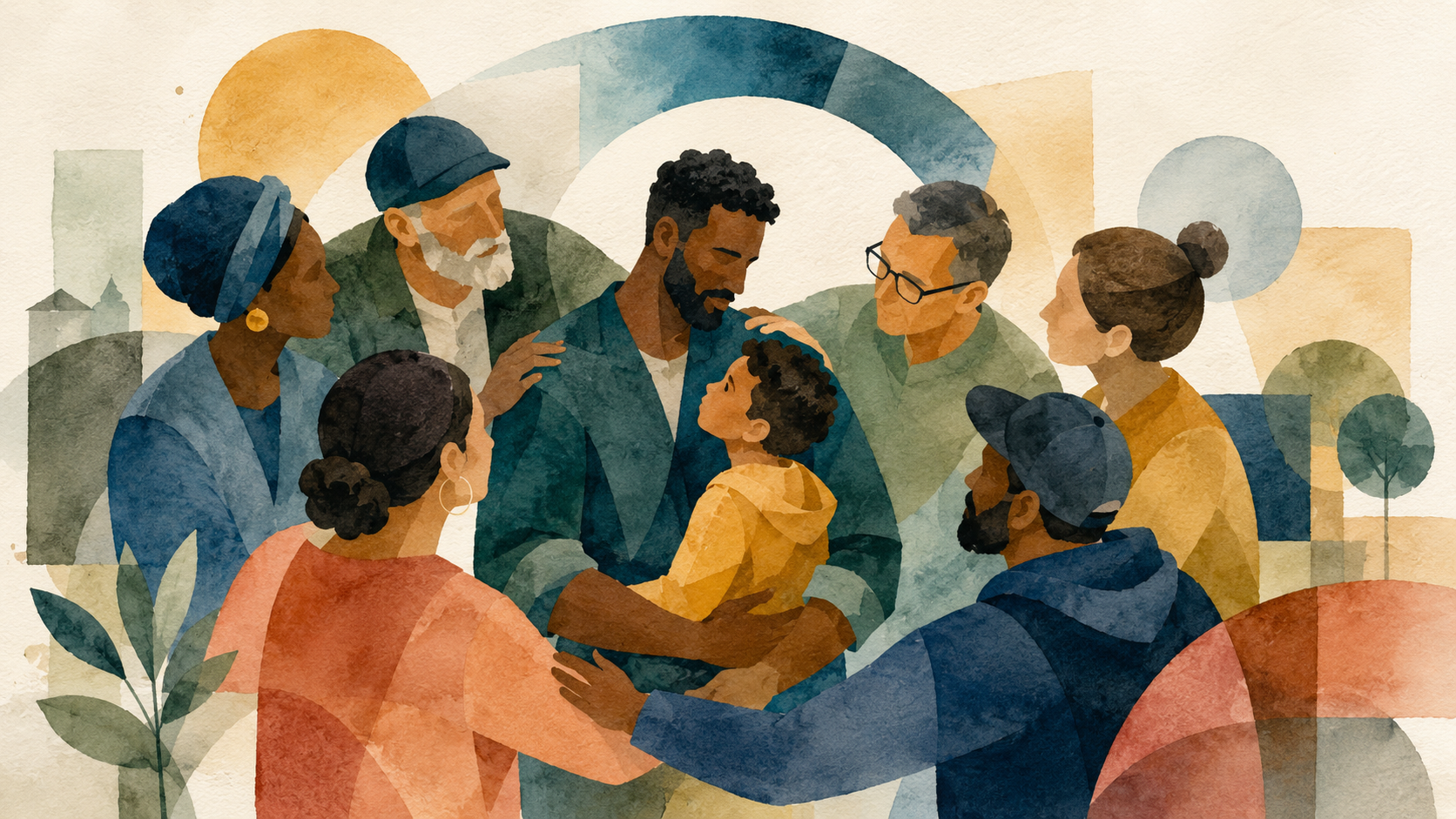
If you’re a single father, there’s a good chance you’ve never sat down and mapped out who is actually in your corner. Most of the dads I work with haven’t. They know who picks up the kids on Tuesdays, who they call if the car breaks down, and who they’d text if there were a real emergency. But when I ask, “Who do you call just to talk — no agenda, no crisis?” I often get a long pause.
That pause is the whole reason I wanted to write this article. As a therapist who works with individuals and couples — including a fair number of single fathers, blended families, and partners of single dads — I’ve watched a very specific pattern play out over and over: single fathers are often excellent at building logistical support (childcare, schedules, finances) and much weaker at building relational support (people who know how they’re actually doing). Both matter. Only one usually gets built without help.
What “Support System” Actually Means for a Single Father
A support system is the full network of people, communities, and resources a person can draw on for emotional, practical, and informational help. For single fathers specifically, a functional support system usually spans six overlapping layers: family and kin, close friendships, a practical co-parenting or “village” network, father-specific community (in person or online), professional support like therapy, and workplace or paid logistical help. Most single fathers I meet have built one or two of these layers reasonably well — usually the practical ones — while the relational layers (friendship, community, therapy) have quietly atrophied or never existed in the first place.
This matters because each layer does a different job. Family might help with childcare in a pinch. A therapist helps you process the identity shift of single fatherhood. A friend group gives you somewhere to be a person instead of only a parent. When one layer is missing, the others get overloaded trying to compensate — and that overload is where I see a lot of single fathers, and the people who love them, start to burn out.
The Patterns I See in My Practice
After years of clinical work with single dads, their co-parents, and the partners who eventually date or marry them, a handful of patterns show up again and again. Naming them tends to be the fastest way for a client to recognize where their own support system has a gap.
1. The “I’ll Just Handle It” Pattern
This is the most common one by far. Many of the single fathers I see were raised — explicitly or implicitly — to believe that needing help is a sign of weakness or poor planning. In practice, this shows up as a man who has a genuinely competent logistical system (school pickup covered, meals planned, bills automated) but almost no one he turns to emotionally. He’ll describe “handling” a diagnosis, a layoff, or a custody dispute entirely alone, often not mentioning it to anyone until months later, if at all. This tracks with broader research on men’s social patterns: men are consistently less likely than women to name emotional distress directly or to seek support proactively, and are more likely to let it surface as irritability, overwork, or withdrawal instead.
2. The Support System That Shrinks to One Person
I see this constantly, and it has a name researchers have recently started using: “mankeeping.” As men’s broader friendship networks shrink, they increasingly rely on a single relationship — usually a romantic partner, sometimes their own child — to do the emotional work an entire network used to share. Stanford researcher Angelica Puzio Ferrara’s work on this describes how men’s networks are becoming “thinner in depth, less frequent in emotional disclosure,” which pushes the burden of maintaining men’s emotional wellbeing onto the one person left standing (Stanford Clayman Institute for Gender Research). For a single father, that one person is often a new girlfriend or partner, and it’s one of the most common issues I see in early-stage couples work with blended families: a partner who says, almost verbatim, “I love him, but I feel like I’m his therapist, his best friend, and his co-parent all at once — and I have nowhere for my own needs to go.”
The other version of this pattern is even harder to see from the outside: a single father who, without meaning to, starts treating his own child as his primary confidant. This isn’t the same as being close to your kids — it’s a subtler dynamic where a dad shares adult-level worries, leans on a teenager for emotional reassurance, or structures his week around not being alone with his own thoughts rather than around what his child actually needs. I gently flag this in session as soon as I see it, because it tends to create anxiety in kids who sense they’re responsible for their father’s emotional state, even when nothing is said outright.
3. The Silent Support Gap After Divorce or Separation
A support system rarely collapses all at once — it usually erodes gradually, and divorce is one of the biggest accelerants. Fathers frequently lose access to an entire layer of family support they didn’t build themselves: in-laws, their ex’s extended family, and the “kinkeeper” role their former spouse played in scheduling holidays, coordinating with schools, or organizing social plans. Research on single-father families notes that as the number and diversity of single-father households has grown substantially over recent decades, the research and social infrastructure supporting them has been slower to catch up, leaving many fathers navigating unfamiliar territory with fewer built-in models to follow (Coles, Journal of Family Theory & Review, 2015). I regularly work with fathers who tell me they simply didn’t realize how much of their social calendar was run by someone else until it stopped happening.
4. Identity-Specific Gaps: LGBTQ+ and Intercultural Single Fathers
Given the populations I work with, I want to name a pattern that’s easy to miss in general-audience advice: the shape of the support gap often depends on identity. Gay single fathers I’ve worked with sometimes describe feeling like an outlier twice over — not quite fitting into straight parenting communities and not always finding themselves represented in LGBTQ+ social spaces built primarily around dating and nightlife rather than parenting. Interestingly, a 2022 mixed-methods study of solo fathers (many of whom were gay men who became parents via surrogacy) found no statistically significant differences between solo fathers and solo mothers in perceived social support, depression, anxiety, or parenting stress — but both groups had to intentionally seek out supportive networks before and after becoming parents; it rarely happened by default (Jones, Zadeh, Jadva & Golombok, International Journal of Environmental Research and Public Health, 2022). That finding matters clinically: it suggests the gap isn’t about capability, it’s about access — and access is exactly what a deliberate support-building plan can fix.
I see something structurally similar with intercultural and immigrant single fathers, particularly in South Asian and other collectivist-culture families I work with. Extended family is often assumed to be the default support system, but distance, estrangement after a difficult divorce, or cultural stigma around single fatherhood can cut that off entirely — leaving a father without the community his culture assumes he’d have, and without the individualist “build your own friend group” script that’s more common in mainstream American culture either.
What Couples Therapy Teaches Us About Single Fathers’ Support Systems
Some of my clearest insight into single fathers’ support systems doesn’t come from working with single dads directly — it comes from couples therapy with people who are dating or married to one.
A recurring dynamic: a single father meets someone new, and because his support system had shrunk down to almost nothing during his years of solo parenting, the new partner gets loaded with an enormous amount of emotional weight very quickly — often before the relationship has had time to build the trust and shared history to support it. The partner frequently isn’t resentful of the parenting itself; they’re overwhelmed by being the only adult relationship in the picture. When I work with these couples, a large part of the early work is simply helping the father rebuild layers of support that existed before the relationship even started, which — counterintuitively — tends to strengthen the new relationship rather than distract from it. A partner who isn’t the sole source of a man’s emotional support almost always reports higher relationship satisfaction than one who is.
I’ve also noticed that fathers who came into a new relationship with at least one other solid support layer already in place — a close friend, a men’s group, an ongoing therapy relationship — adapt to the normal friction of blended-family life with noticeably more resilience than fathers who are relying entirely on the new partner to hold everything together.
Why This Matters: The Research Behind the Pattern
None of this is anecdotal. Several converging bodies of research point in the same direction.
Men’s close friendship networks have declined sharply over the past three decades. Thirty years ago, 55% of American men reported having six or more close friends; today that number has been cut roughly in half, to 27%, while the share of men with zero close friends has increased fivefold, from 3% to 15% (Survey Center on American Life, 2021). Single fathers are not exempt from this trend — if anything, the loss of a spouse’s social coordination on top of an already-shrinking friend network compounds the effect.
Internationally, the data on single fathers’ distress is sobering where it has been studied directly. A 2023 national study in Japan found measurably elevated rates of psychological distress among single fathers compared with partnered fathers, using a validated clinical screening scale across a sample of nearly 45,000 fathers (Dhungel et al., Journal of Epidemiology, 2023). A 2025 Swedish study similarly found that single fathers navigating early parenthood reported distinct, often unmet, needs for support from health professionals compared with coupled fathers — even in a country with a robust social safety net (Wells & Kerstis, American Journal of Men’s Health, 2025).
Here in the U.S., single-father families remain a demographic minority that the surrounding social infrastructure hasn’t fully caught up with. Roughly 10.9 million one-parent family groups in the U.S. include a child under 18, and while the large majority are maintained by mothers, an estimated one in five — an estimated 2 million or more households — are maintained by a father (U.S. Census Bureau, 2022). Being a numerical minority in nearly every parenting space — school pickup lines, parent social groups, pediatrician waiting rooms — adds a quiet, cumulative sense of being an outlier that most support resources aren’t built to address.
The Six Layers of a Strong Support System
This is the framework I actually walk through with clients. I introduce these roughly in this order, because the first two or three tend to be the most neglected and the highest-leverage to rebuild.
- Family and kin. Even if your relationship with extended family has changed since a divorce or separation, take an honest inventory of who is still available — a sibling, a parent, a cousin, even an in-law you’re still close with. Reach out with a specific, low-pressure ask (“Could you take the kids one Saturday a month?”) rather than a vague one. Specific requests get said yes to far more often than general ones.
- Close friendships built for depth, not just proximity. Other parents at school pickup are a start, but they’re not the same as someone who knows how you’re actually doing. I ask clients to identify one existing relationship that has the potential to deepen and to be intentional about it — a recurring coffee, a standing text check-in, an invitation to something outside of “kid stuff.” Consistency, not chemistry, is what turns an acquaintance into a real support.
- A practical co-parenting or “village” network. This is the logistical layer most single fathers already build reasonably well, but it’s worth being deliberate about expanding it: a rotating carpool with two or three other families, a trusted backup for last-minute childcare, a neighbor who can grab your kid from the bus if you’re stuck at work. The goal is redundancy — no single point of failure.
- Father-specific community. Other single dads understand the specific mix of logistics, guilt, and grief involved in a way that friends without kids — or friends in intact marriages — often can’t fully relate to. Local single-parent or fatherhood groups, community-center programs, and online communities designed specifically for single dads can shortcut a lot of the vulnerability barrier that keeps men from opening up in general social settings.
- Professional support. A therapist is not a replacement for friends or family, but it’s the one layer of your support system with zero risk of burdening the other person, zero social obligation, and complete confidentiality. In my experience, single fathers who add this layer tend to rebuild the other layers faster, because therapy is often where the “I’ll just handle it” belief gets examined and loosened for the first time.
- Workplace flexibility and paid help. This layer gets overlooked constantly, but it’s often the most efficient one to build. A cleaning service every other week, a grocery delivery subscription, or an honest conversation with a manager about flexible hours around custody schedules can free up the bandwidth needed to actually invest in the relational layers above. Outsourcing a task isn’t a failure of independence — it’s a redistribution of energy toward the support that actually needs a human, not a checklist.
Signs Your Support System Needs Rebuilding
A few signals I look for with clients, in order of how commonly they show up:
- You can name who handles logistics in a crisis but struggle to name who you’d call just to talk.
- One person — a partner, an ex, or your own child — is carrying most of your emotional weight.
- You’ve turned down invitations for months because you’re “too busy,” even when you have some bandwidth.
- You haven’t had an unscripted, non-parenting conversation with another adult in weeks.
- You feel guilty at the idea of spending time or money on your own social life instead of your kids.
- A new or existing partner has told you they feel like your only source of emotional support.
None of these mean something is wrong with you. They mean a layer of your support system has quietly gone missing — and that is fixable with the right, specific steps.
Frequently Asked Questions
What does a healthy support system look like for a single father?
It typically spans six layers: family, close friendships, a practical co-parenting or “village” network, father-specific community, professional support like therapy, and workplace or paid logistical help. Most single fathers have built the practical layers well and neglected the relational ones.
Why do single fathers struggle to build friendships as adults?
Men’s close friendship networks have shrunk significantly over the past three decades, and about one in five men in the U.S. report having no close friends at all (Survey Center on American Life, 2021; Stanford Clayman Institute). For single fathers, this is often compounded by lost family connections after a divorce and limited free time.
Is it a problem if my partner is my main source of emotional support?
It can be. This pattern, sometimes called “mankeeping,” places an outsized emotional load on one relationship and is a common source of strain in couples where one partner is a single father. A broader support network protects both the relationship and your own wellbeing.
Can therapy really help with building a support system, or is that something I have to do on my own?
Therapy is often the fastest way to start. It’s a low-risk place to practice being vulnerable, to examine beliefs that make asking for help feel unsafe, and to build a concrete, personalized plan for the other layers of support — rather than trying to figure it out alone.
Do single fathers actually experience more distress than partnered fathers?
Research suggests yes in several contexts — a large national study in Japan found elevated psychological distress among single fathers compared with partnered fathers (Dhungel et al., 2023), and a 2025 Swedish study found single fathers reported distinct, often unmet, support needs compared with coupled fathers (Wells & Kerstis, 2025). The encouraging finding is that when solo fathers actively build supportive networks, their wellbeing outcomes can look comparable to solo mothers’ (Jones et al., 2022).
You Don’t Have to Build This Alone
If you recognized yourself in any of these patterns — the “I’ll just handle it” instinct, a support system that’s quietly narrowed down to one person, or the sense that you’ve been carrying more than anyone realizes — I want you to know that rebuilding a support system is exactly the kind of work I help clients with every week, both individually and alongside the partners and co-parents in their lives. I offer a free 20-30 minute consultation call, with no pressure and no obligation, so we can talk through what’s going on for you and figure out together whether working together makes sense. If you’re ready to stop carrying it all alone, reach out to schedule your free consultation.

Dipesh Patel, MBA, MSW, LCSW, LICSW is an individual and couples therapist specializing in Gottman Method Couples Therapy and emotionally focused therapy. He works with high-achieving professionals, the LGBTQ community, first-generation Americans, and multicultural couples navigating relationship stress and life transitions.
Sources
- Cox, Daniel A. “Men’s Social Circles are Shrinking.” Survey Center on American Life. (2021). https://www.americansurveycenter.org/why-mens-social-circles-are-shrinking/
- “The structural burden of men’s declining social networks.” Stanford University Clayman Institute for Gender Research. https://gender.stanford.edu/news/structural-burden-mens-declining-social-networks
- Jones, C., Zadeh, S., Jadva, V., & Golombok, S. “Solo Fathers and Mothers: An Exploration of Well-Being, Social Support and Social Approval.” International Journal of Environmental Research and Public Health, 19(15), 9236. (2022). https://pmc.ncbi.nlm.nih.gov/articles/PMC9368669/
- Dhungel, B., Kato, T., Kachi, Y., Ochi, M., Gilmour, S., & Takehara, K. “Prevalence and Associated Factors of Psychological Distress Among Single Fathers in Japan.” Journal of Epidemiology. (2023). https://www.jstage.jst.go.jp/article/jea/advpub/0/advpub_JE20210273/pdf/-char/en
- Wells, M. B., & Kerstis, B. “Navigating Parenthood Alone: A Mixed-Method Study of Single Fathers’ Experiences and Needs Regarding Received Midwife and Child Health Nurse Support in Sweden.” American Journal of Men’s Health, 19(4). (2025). https://pmc.ncbi.nlm.nih.gov/articles/PMC12317203/
- Coles, R. L. “Single-Father Families: A Review of the Literature.” Journal of Family Theory & Review. (2015). https://onlinelibrary.wiley.com/doi/10.1111/jftr.12069
- U.S. Census Bureau. “Census Bureau Releases New Estimates on America’s Families and Living Arrangements.” (2022). https://www.census.gov/newsroom/press-releases/2022/americas-families-and-living-arrangements.html
You must be logged in to post a comment.