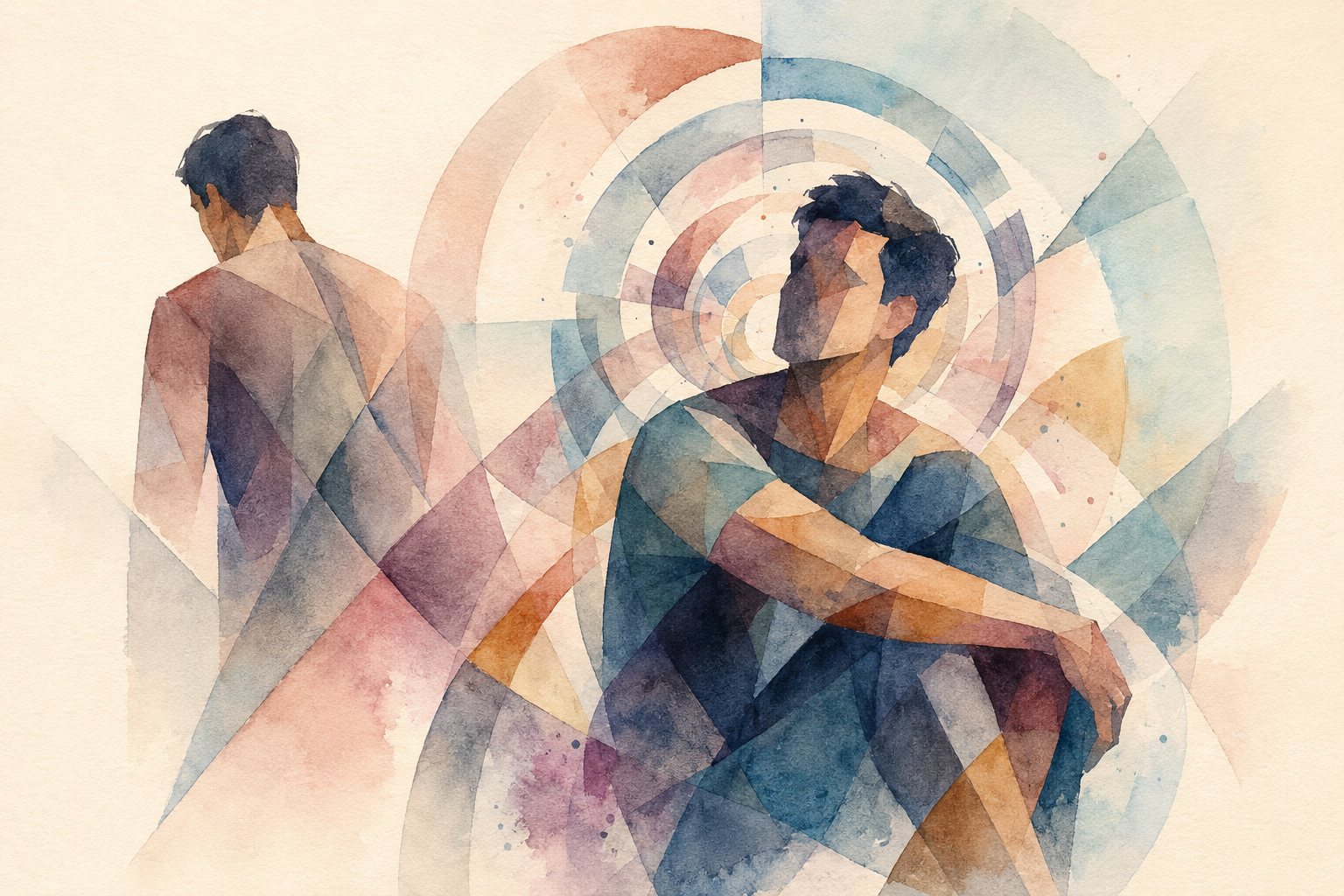
If you have ever stared at a dating app after a match suddenly unmatched you, or replayed a first date that seemed to go well until it quietly disappeared into silence, you already know something most articles about dating skip over: rejection in gay dating does not just sting. For a lot of the men I work with, it detonates. One unanswered message can spiral into a full evening of self-interrogation — What’s wrong with me? Am I too much? Not enough? Will this always be my life?
In my practice, I work with gay and queer men both individually and in couples, and rejection is one of the most common threads that brings people through my virtual door. Not because my clients are fragile, but because they are human beings navigating a dating landscape that is uniquely fast, uniquely visual, and layered on top of a lifetime of experiences that taught many of them to expect rejection before it ever arrives.
This article is about how to feel the sting of rejection without letting it hijack your sense of self. It is written from what I see, week after week, in the therapy room — and it is grounded in the research that helps explain why this hurts the way it does, and what actually helps.
Why Rejection in Gay Dating Hits Differently
Let me name something directly, because I think naming it is the first step toward not being controlled by it: rejection tends to land harder for gay and bisexual men than the “just brush it off” advice acknowledges. There are real, well-documented reasons for that.
The minority stress you carry into every date
Psychologists use the term minority stress to describe the unique, chronic stressors that sexual and gender minorities experience simply because of who they are. According to research published by Oxford Academic, minority populations are exposed to unique stressors including stigma, expectations of rejection, experiences of discrimination, and the internalization of negative social beliefs about one’s own group. That phrase — expectations of rejection — is worth sitting with. It means many gay men walk into dating already primed, often unconsciously, to anticipate being turned away.
This isn’t a character flaw. It is a nervous system that adapted to an environment. If you grew up scanning rooms to figure out whether it was safe to be yourself, whether a crush might react with disgust, or whether coming out might cost you a friendship or a family relationship, your brain got very, very good at detecting threat of rejection. That same finely-tuned radar doesn’t switch off when you open Grindr or Hinge. It fires when a text goes unanswered.
The same body of research notes that internalized homonegativity — the absorption of society’s negative messages about being gay — is associated with lower relationship quality at both the individual and couple level, per the Oxford Academic review of minority stress and relationships. In plain terms: when a part of you quietly believes there’s something shameful or unlovable about your identity, every rejection can feel like confirmation of that belief rather than a neutral mismatch.
When the pain is disproportionate: rejection sensitivity
Some of my clients describe a reaction to rejection that goes beyond ordinary disappointment — an emotional response so intense it feels physical. There’s a term worth knowing here: rejection sensitive dysphoria (RSD). The Cleveland Clinic describes RSD as severe emotional pain triggered by failure or the feeling of being rejected — pain that is “stronger and can be harder to manage” than the ordinary discomfort of rejection. Cleveland Clinic also notes that people who experience this “are more likely to interpret vague interactions as rejection and may find it difficult to control their reactions.”
Read that last line again if you’re someone who agonizes over whether “haha” means he’s losing interest. That tendency to read ambiguity as rejection is real, it has a name, and it is not you being crazy or needy.
RSD is most often discussed in connection with ADHD, and it is not an official diagnosis on its own. But you don’t need a formal label to recognize the pattern. What matters is understanding that, per Cleveland Clinic, social rejection — even when it’s vague or uncertain — produces brain activity similar to physical pain. Your spiral after a bad date isn’t drama. It’s your brain processing rejection through the same circuitry that processes injury.
The Dating App Amplifier
I could not write honestly about gay dating in 2026 without talking about apps. For many of my clients, apps are simultaneously the primary way they meet people and the primary source of their distress. The research is catching up to what I hear in session.
A 2026 study published in Media Psychology via Taylor & Francis found that receiving an unmatching notification on a dating app significantly threatened people’s fundamental needs — belonging, self-esteem, meaningful existence, and control — increased negative affect, and evoked ruminative thoughts. Rumination is the technical word for exactly what my clients describe: the loop you can’t turn off, the replaying, the “what did I do wrong.”
A separate study found a strong negative correlation between rejection experienced on dating apps and self-esteem, reported in the International Journal of Indian Psychology, where researchers noted that “qualitative experiences, such as being rejected or accepted, matter more than just screen time in determining psychological outcomes.” In other words, it isn’t how long you spend on the app that hurts you — it’s how the rejections feel.
And there’s the loneliness piece. Research examining dating apps has raised concern that platforms have shifted from facilitating real-world connection toward “match accumulation,” which some studies associate with lower self-esteem and higher loneliness, as discussed in work published on PubMed Central. For gay men — who may have a smaller dating pool in their immediate geography and rely more heavily on apps — this dynamic can be intensified.
Here’s what I want you to take from the research: the apps are engineered in a way that manufactures frequent micro-rejections, and your pain in response to that is a normal reaction to an abnormal volume of rejection. You are not weak for struggling with a system designed to keep you swiping.
Patterns I See in the Therapy Room
After years of working with gay and queer individuals and couples, certain patterns show up again and again. You may recognize yourself in one or more of these. Recognizing the pattern is powerful, because a pattern you can name is a pattern you can interrupt.
Pattern 1: Rejection becomes a referendum on your worth
The single most common distortion I see is what therapists call overgeneralization — taking one specific event and turning it into a sweeping global truth. He didn’t text back becomes I’m unlovable. A date that fizzled becomes I’ll be alone forever. One person’s preference gets promoted to a verdict on your entire being.
In session, I often ask clients to notice the exact moment a specific fact (“he didn’t respond”) transforms into an identity statement (“I’m not worth responding to”). That leap happens in a fraction of a second, and it is the hinge on which the whole spiral turns.
Pattern 2: The pre-emptive strike
Some clients protect themselves from anticipated rejection by rejecting first — ghosting before they can be ghosted, picking fights, or finding fatal flaws in someone who was actually a good match. This connects directly to those expectations of rejection baked in by minority stress. If you’re certain the ending will be painful, ending it early can feel like control. But it also guarantees the loneliness you were trying to avoid.
Pattern 3: People-pleasing and shape-shifting
The Cleveland Clinic notes that people who are highly sensitive to rejection are often “people pleasers” who become “intensely focused on avoiding the disapproval of others.” In dating, this looks like agreeing to things you don’t want, hiding your actual opinions, muting your personality, or contorting yourself into whatever you think he wants. The tragic irony: when you disappear yourself to avoid rejection, even the acceptance you win doesn’t feel like it’s for the real you — so it never soothes the underlying fear.
Pattern 4: Bringing old rejection into a good relationship
This one shows up in my couples work. A partner who carries unhealed rejection wounds may test the relationship, read neutral behavior as abandonment, or spiral when their partner needs space. The Oxford Academic research on minority stress found that internalized homonegativity and identity concealment can have significant negative effects on same-sex relationships. Sometimes the call is coming from inside the house — the rejection you fear from your partner is an echo of rejection you experienced long ago.
Pattern 5: The high-achiever who’s quietly falling apart
Many of the high-performing gay men I work with cope with rejection fear by going all-out — perfectionism, over-achievement, becoming impressive. The Cleveland Clinic specifically describes this: some people “compensate for their fear of failure or rejection by going all-out or striving for perfectionism,” at the cost of intense anxiety and neglected self-care. On the outside, it looks like success. On the inside, dating rejection cuts straight through the armor because it’s the one arena achievement can’t fully control.
How to Navigate Rejection Without Spiraling
Understanding why rejection hurts is the foundation. Now let’s talk about what to actually do when it happens. These are strategies I use with clients — practical, evidence-informed, and designed for the real moments when your chest tightens after a message goes unread.
1. Interrupt the spiral in the body first
When rejection hits and the brain starts racing, you cannot reason your way out immediately, because the pain response is physiological. Start with the body. Slow your exhale — breathe out longer than you breathe in. Put a hand on your chest. The goal isn’t to make the feeling disappear; it’s to signal to your nervous system that you are not actually in danger. Once your body settles, your thinking brain comes back online and you can do the cognitive work below.
2. Separate the fact from the story
This is the core skill. When you feel the spiral start, write down two columns.
- The fact: “He didn’t respond to my last message.”
- The story: “I’m unlovable and I’ll be alone forever.”
Seeing them side by side reveals how much interpretation you’ve stacked on top of a small, neutral event. The Cleveland Clinic notes that therapy helps people “learn how to process and manage feelings so they’re less overwhelming” and to “adapt your thought processes.” This exercise is that adaptation in miniature. The fact is survivable. The story is what spirals.
3. Reframe rejection as data, not a verdict
A person declining a date with you is information about fit, not a ruling on your worth. A closed door tells you that particular door wasn’t yours — it says nothing about the doors ahead. When you match with someone who wants a hookup and you want a relationship, their disinterest isn’t rejection; it’s the system correctly filtering out a mismatch. Reframing experiences is, notably, one of the coping strategies the Oxford Academic research identifies that same-sex couples use to buffer minority stress. You can apply that same reframing muscle to dating.
4. Practice self-compassion instead of self-attack
Research on online dating rejection has examined self-compassion as a protective buffer against the mental-health impact of rejection, as explored in work archived at the University of Twente. Self-compassion means talking to yourself the way you’d talk to a good friend after a bad date. You would never tell a friend, “Yeah, that proves you’re unlovable.” You’d say, “That’s disappointing, and it’s his loss.” Give yourself that same voice. The Cleveland Clinic puts it plainly in its guidance for living with rejection sensitivity: “Be nicer to yourself.”
5. Curate your app relationship deliberately
Given what the research shows about apps manufacturing constant micro-rejections and driving rumination — per the Taylor & Francis study — treat the apps as a tool with a dose, not a lifestyle. Set time limits. Take deliberate breaks. Notice when swiping has stopped being hopeful and started being self-punishing. Because research on PubMed Central links match-accumulation dynamics to loneliness and lower self-esteem, protecting your mental health may mean deprioritizing the very platforms that promise connection but often deliver depletion. Meeting people through friends, community events, hobbies, and queer spaces spreads your emotional eggs across more baskets.
6. Widen your identity beyond your dating life
When your entire sense of worth is riding on whether someone swipes right, every rejection is catastrophic because it’s threatening your whole identity. The clients who weather rejection best are the ones with a full life outside of dating — friendships, meaningful work, creative outlets, a spiritual or community practice, a body they move and care for. Dating becomes one part of a rich life rather than the referendum on whether the life is worth living. The Oxford Academic research consistently names self-esteem, social support, and problem-solving as protective factors that buffer minority stress. Build those on purpose.
7. Address the root, not just the symptom
If rejection consistently sends you into spirals that last days, disrupt your sleep, or make you want to give up on connection entirely, the issue usually isn’t this particular guy or this particular app. It’s an older wound the dating is pressing on. This is where therapy does its deepest work — not by making rejection stop happening, but by changing your relationship to it, so a “no” becomes a survivable event instead of an existential threat. The Cleveland Clinic is direct that for many people, “it’s difficult” to manage severe rejection sensitivity alone, and that therapy “offers the best chance” of learning to live with it well.
For Couples: When Rejection Fear Lives Inside the Relationship
Rejection doesn’t end when you find a partner. In my couples work, I often see two people who love each other but keep reactivating each other’s old rejection wounds. One partner needs alone time; the other reads it as withdrawal and panics. One partner gives feedback; the other hears total condemnation. The Cleveland Clinic describes how people sensitive to rejection may “interpret vague interactions as rejection” — and inside a relationship, there are a lot of vague interactions to misread.
The work here is twofold. First, the partner carrying rejection sensitivity learns to recognize when they’re reacting to a ghost from the past rather than to their actual partner. Second, the couple builds a shared language for reassurance and repair, so that when a wound gets activated, it becomes an opportunity for closeness rather than a rupture. The Oxford Academic research even notes that some same-sex couples use stigma and stress “as an opportunity to strengthen their relationship.” Rejection fear, handled together, can become one of those opportunities.
Frequently Asked Questions
Why does rejection in gay dating hurt so much more than it seems like it should?
Because for many gay and bisexual men, dating rejection lands on top of years of minority stress — the chronic stigma, discrimination, and expectations of rejection documented in minority stress research. Your nervous system may be primed to anticipate rejection, so a single “no” can activate a much older and deeper fear.
Is it normal to spiral for days after being rejected on a dating app?
It’s common, and there’s a reason. Research in Media Psychology found that app rejections like unmatching increase rumination and threaten core needs like belonging and self-esteem. That said, if spirals routinely last for days and disrupt your functioning, that’s a strong sign that working with a therapist could genuinely help.
What is rejection sensitive dysphoria, and do I have it?
Per the Cleveland Clinic, rejection sensitive dysphoria (RSD) is severe emotional pain triggered by rejection or perceived rejection, often linked to ADHD. It’s not an official standalone diagnosis, so only a qualified provider can help you understand what’s driving your experience — but the framework can be a useful lens for self-understanding.
Should I quit dating apps entirely?
Not necessarily — but be intentional. Because research links match-accumulation app dynamics to loneliness and lower self-esteem, it’s worth setting limits, taking breaks, and making sure apps are one channel among several rather than your only source of connection and validation.
Can therapy actually make rejection stop hurting?
Therapy won’t make rejection stop happening, and it won’t erase the sting entirely. What it can do — as the Cleveland Clinic describes — is help you process and manage those feelings so they’re less overwhelming, and help you build new thought patterns so a rejection becomes a survivable moment instead of a spiral.
You Don’t Have to Untangle This Alone
Rejection is part of dating for everyone. But if you’re a gay or queer man whose rejections keep turning into spirals — the kind that steal your sleep, shrink your world, or make you want to give up on love entirely — that’s not a sign something is broken in you. It’s a sign you’re carrying something worth setting down, and it usually points to a wound that deserves care, not more self-criticism.
In my practice, I help gay and queer individuals and couples change their relationship to rejection: to feel the sting without being consumed by it, to separate a single “no” from their worth as a person, and to build the kind of self-trust that makes dating feel less like a threat and more like an open possibility. This work is done via telehealth, so we can meet wherever you are.
If any of this resonated, I’d love to talk. I offer a free 20–30 minute consultation call — a no-pressure conversation to hear what’s going on, answer your questions, and figure out together whether we’re a good fit. You don’t have to have it all figured out before you reach out. That’s what the call is for.

Dipesh Patel, MBA, MSW, LCSW, LICSW is an individual and couples therapist specializing in Gottman Method Couples Therapy and emotionally focused therapy. He works with high-achieving professionals, the LGBTQ community, first-generation Americans, and multicultural couples navigating relationship stress and life transitions.
Sources
- Powers, M. “Minority Stress and Relationships.” Oxford Academic. https://academic.oup.com/edited-volume/61798/chapter/546225272?guestAccessKey=
- Cleveland Clinic. “Rejection Sensitive Dysphoria (RSD): Symptoms & Treatment.” https://my.clevelandclinic.org/health/diseases/24099-rejection-sensitive-dysphoria-rsd
- “Swipe, Chat, Unmatch: The Psychological Consequences of Being Rejected on Dating Apps.” Media Psychology, Taylor & Francis (2026). https://www.tandfonline.com/doi/full/10.1080/15213269.2026.2633228
- “Swiping vs. Scrolling: Examining the Impact of Dating Apps on Self-Esteem.” International Journal of Indian Psychology (2026). https://ijip.in/wp-content/uploads/2026/03/18.01.316.20251304.pdf
- “Are Dating App Algorithms Making Men Lonely?” PubMed Central. https://pmc.ncbi.nlm.nih.gov/articles/PMC12012395/
- Musan, “Rejection in Online Dating, Mental Wellbeing and Self-Compassion.” University of Twente. https://essay.utwente.nl/81602/1/Musan_BA_BMS.pdf
Response
[…] This article is about that weight: why it exists, the patterns I see it create in individuals and relationships, and what actually helps protect your mental health while you keep dating. […]