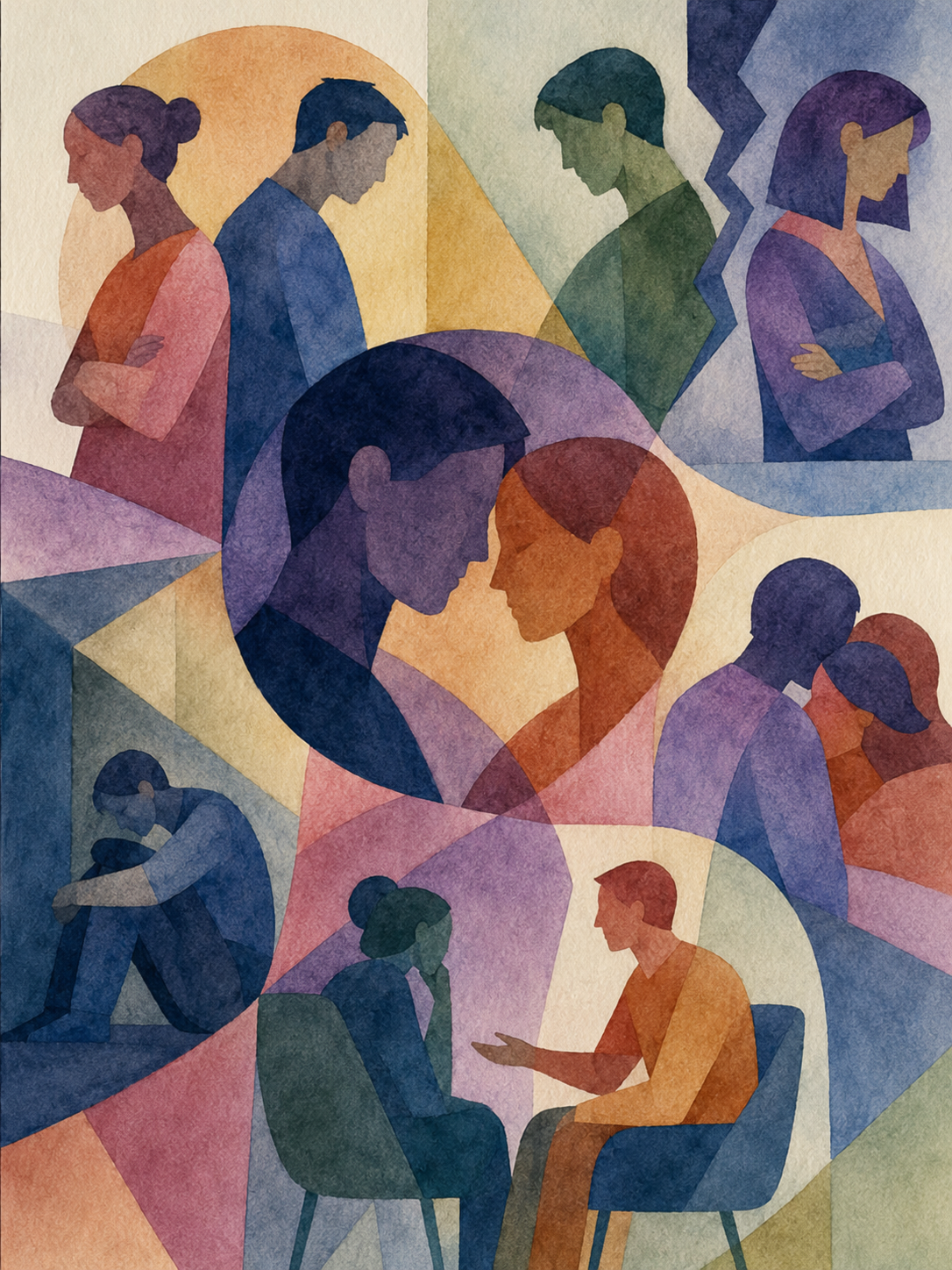

Your LGBTQ relationship may benefit from therapy if you’re seeing repeating patterns of disconnection, unspoken resentment, and stress from outside your relationship that you can’t seem to shift on your own. As an affirming couples therapist, I see the same themes show up again and again with queer and trans couples—and the earlier you respond to these signs, the easier it usually is to repair, reconnect, and grow together.
Why LGBTQ Couples Face Unique Strain
Even the most loving LGBTQ relationships don’t exist in a vacuum—they’re shaped by family, culture, religion, racism, cissexism, and homophobia, both subtle and overt. Many couples I work with are not “broken”; they are carrying more than most relationships were ever designed to hold alone.
Common contextual pressures I see include:
- Different levels of “outness” at work, with family, or in faith communities.
- Past experiences of rejection or shame that now show up as reactivity, avoidance, or difficulty trusting.
- Safety concerns in public spaces or around certain relatives, especially for trans and gender-expansive partners.
- Intersectional stressors for BIPOC, immigrant, and first-gen LGBTQ partners who are navigating racism and queerphobia at the same time.
In therapy, we don’t just look at “communication skills” in isolation; we explore what it means to try to stay connected while swimming against all of these currents.
Sign 1: Communication Feels Unsafe or Pointless
One of the clearest signs your LGBTQ relationship may need therapy is when talking no longer feels like a path to understanding—it feels like a risk or a dead end. I often hear some version of, “We can’t talk about anything serious without it blowing up,” or “If I’m honest, I’m afraid to say how I really feel.”
Patterns I frequently see:
- You avoid topics like sex, gender, family, or money because they reliably lead to conflict or shutdown.
- You repeat the same arguments with different details but the same emotional script—defensiveness, blame, withdrawal.
- One or both of you feels chronically misunderstood or misrepresented: “That’s not what I meant at all.”
- You start editing yourself to keep the peace, especially around your queer or trans identity.
Research and clinical experience both emphasize that persistent communication problems strongly predict relationship distress. In LGBTQ couples, these issues are often intensified by fear of confirming harmful stereotypes (“the dramatic gay couple,” “the angry queer person”) or by being used to not being heard in other areas of life.
Therapy can help you:
- Slow down your patterns so you can actually see what happens between stimulus and reaction.
- Build communication tools that emphasize emotional safety, not just “arguing better.”
- Practice having hard conversations about your identities, needs, and fears in a space that stays grounded and affirming.
Sign 2: The Same Painful Conflict Keeps Coming Back
Another major sign I see is a cycle of recurring conflict that never really gets resolved—just paused until the next time. You may apologize, make up, and then find yourselves right back in the same emotional place weeks or months later.
Common LGBTQ-specific conflict themes include:
- Different timelines for coming out or being public as a couple (for example, one partner wants to hold hands in public; the other fears harassment or family fallout).
- Tension around how to navigate holidays, religious rituals, or family events when your relationship or identities aren’t fully accepted.
- Disagreements about gender transition, pronoun changes, or name changes and how to communicate that to others.
- Conflicts about boundaries with exes, queer chosen family, or poly/ENM communities.
From the outside, these arguments might look like “just another fight.” But underneath, they usually touch deep fears: Will you still want me if I change? Will you protect our relationship when it’s hard? Will we ever get to live openly and safely together?
In therapy, we focus less on “winning” the disagreement and more on understanding what each partner is protecting or afraid of. When couples learn to identify the underlying attachment needs and trauma triggers beneath their repeated conflicts, the content of the fight finally starts to change.
Sign 3: External Stressors Are Driving You Apart Instead of Closer
LGBTQ couples live with a higher baseline of external stress than many straight, cisgender couples, simply because of stigma, discrimination, and safety concerns. Over time, if this stress isn’t named and shared, it can quietly erode your connection.
Signs external stress is taking over your relationship:
- One or both of you comes home from work or social spaces emotionally exhausted from microaggressions or outright hostility, and that stress gets displaced onto each other.
- You disagree about how “out” to be in certain environments because of real or perceived safety issues.
- You find yourselves arguing about minor issues (dishes, chores, schedules) when the real problem is feeling unsupported in a hostile world.
- Experiences of racism, transphobia, or biphobia toward one partner go unacknowledged or minimized by the other, leaving that person feeling deeply alone.
Studies of minority stress show that chronic exposure to discrimination and invalidation is linked to higher rates of depression, anxiety, substance use, and relationship strain among LGBTQ adults. In couples work, we explicitly treat the environment as part of what we’re working with—not just each partner’s individual coping skills.
Therapy can help you:
- Name minority stress and external pressures as shared challenges rather than personal failures.
- Develop strategies to “turn toward” each other when the world feels unsafe or invalidating.
- Build a shared narrative that honors both partners’ identities and experiences, especially in the face of intersecting oppressions.
Sign 4: Intimacy Feels Confusing, Pressured, or Absent
Many LGBTQ couples come to therapy because something in their emotional or physical intimacy has shifted, and they don’t know how to talk about it without shame or defensiveness. Some describe feeling like “roommates,” while others feel pressure to live up to community norms or stereotypes about what their sex life “should” look like.
Trends I see in session:
- Mismatched desire or different comfort levels with touch, affection, or specific types of sexual activity.
- Internalized messages about what bodies are “attractive enough” or “queer enough,” which can lead to avoidance or performance in bed rather than genuine connection.
- Changes in gender identity, hormones, or body image that make intimacy feel unfamiliar or vulnerable, especially for trans and nonbinary partners.
- Avoiding sex altogether because past experiences of shame, dysphoria, or trauma show up when things get physically close.
Research and clinical observation both suggest that intimacy issues are among the top reasons LGBTQ couples seek therapy, alongside communication problems and infidelity. But intimacy isn’t just about sex—it’s about being emotionally known and accepted, including in the parts of you that feel most vulnerable.
In therapy, we might:
- Explore what intimacy actually means to each of you beyond scripts you’ve inherited from straight culture or LGBTQ subcultures.
- Talk openly about bodies, desire, and boundaries in language that feels affirming, not clinical or pathologizing.
- Build rituals of closeness—sexual and nonsexual—that fit who you are now, not who you thought you had to be.
Sign 5: Trust Has Been Damaged—and You Can’t Repair It Alone
When trust feels shaky or broken, couples often wait until they are in deep crisis before reaching out for help. In LGBTQ relationships, breaches of trust can be especially loaded because they may echo earlier experiences of betrayal or rejection around identity.
Common trust ruptures I see:
- Infidelity, secrecy about hookups, or broken agreements in monogamous or non-monogamous structures.
- Hiding major life decisions (like coming out at work, starting hormones, or reconnecting with a rejecting family member) because you fear your partner’s reaction.
- Sharing private information about your partner’s identity, mental health, or history without consent, especially in communities where social circles overlap.
- Repeatedly minimizing your partner’s experiences of discrimination or dysphoria, creating a sense that you are not emotionally safe.
Trust doesn’t heal through time alone; it heals through consistent, reparative experiences where both partners are working toward transparency, accountability, and emotional responsiveness. An LGBTQ-affirming therapist can help you rebuild trust without blaming, shaming, or forcing premature forgiveness.
In our work together, we might:
- Clarify what trust and safety mean to each of you specifically.
- Create concrete, realistic agreements for rebuilding reliability and openness.
- Make space for grief and anger while still holding onto the possibility of repair if both of you want that.
Sign 6: Your Identities Are Evolving—and Your Relationship Is Struggling to Keep Up
Identity is not static, and for many LGBTQ people, understanding of gender, sexuality, relationship style, and community evolves across a lifetime. This growth is healthy, but it can feel destabilizing inside a relationship if you don’t have a shared framework and language for what’s changing.
Common situations I see:
- One partner is exploring a new label (for example, bisexual, pansexual, asexual, nonbinary), and the other worries this means they are “not enough” or will be left.
- A partner’s gender transition shifts how both of you relate to attraction, roles, or public presentation, and you feel unsure how to navigate those shifts together.
- Evolving values around monogamy, kink, or community involvement create new questions about what you each want from the relationship.
- You’re both changing in good ways, but your old patterns of relating haven’t caught up, leading to friction and confusion.
Affirming couples therapy holds space for identity development as a normal part of relational life, not a threat that must be suppressed. We can explore how to update your relational agreements, rituals, and language so your relationship has room to grow alongside you.
Together, we might:
- Map out the story of your relationship and how your identities have evolved over time.
- Identify which old assumptions or unspoken rules no longer fit who you are.
- Co-create new agreements that honor both partners’ authenticity and the health of the relationship.
Sign 7: You Feel More Alone In the Relationship Than Outside It
Perhaps the most painful sign that therapy could help is a growing sense of loneliness or emptiness inside the relationship. Many LGBTQ clients tell me, “I feel more understood by my friends than by my partner,” or “I love them, but I don’t feel emotionally held by them anymore.”
Red flags I listen for in session:
- You regularly censor your queer or trans joy because you don’t think your partner will “get it.”
- You turn to friends, social media, or dating apps for emotional connection rather than talking to each other.
- When something big happens—good or bad—your partner is not the first person you want to tell.
- You feel unseen in your intersecting identities (for example, as a queer person of color, an immigrant, a disabled or neurodivergent partner), even if your partner is “supportive” in a general way.
LGBTQ relationships often form in the context of chosen family and community, which can be deeply nourishing—but your partnership also deserves to be a place where you feel seen, cherished, and emotionally safe. Therapy can help bridge the gap between “we live together” and “we are truly with each other.”
We can work on:
- Naming your specific emotional needs without shame or apology.
- Helping your partner understand what support actually looks like for you, not just in theory.
- Rebuilding small daily practices of reaching for each other so your relationship feels like home again.
How LGBTQ-Affirming Therapy Supports Your Relationship
Affirming couples therapy is not about deciding who is right or wrong; it’s about understanding the patterns you’ve learned to survive and choosing together which ones you want to keep. Studies show that culturally adapted, LGBTQ-affirming couples therapy can improve communication, relationship satisfaction, and individual mental health.
In my work with queer and trans individuals and couples, I focus on:
- Context, not blame – We locate your struggles in the larger systems you live in, not just in each other’s “flaws.”
- Safety and consent – You set the pace. We move in a way that respects your boundaries, identities, and lived experiences.
- Skills and insight – We combine practical tools (like communication and nervous-system regulation) with deeper exploration of attachment, trauma, and identity.
- Intersectional care – We honor how culture, race, migration, gender, sexuality, family history, and work all shape your relationship.
Therapy is not a sign that your relationship is failing; it’s a sign that you care enough to invest in a different way of being together.
You Don’t Have to Do This Alone – Next Step
If you recognize yourself or your relationship in any of these seven signs, you don’t have to wait for things to get worse before you reach out. Support is available, and it can be specifically tailored to LGBTQ relationships, identities, and families.
I offer LGBTQ-affirming individual and couples therapy via telehealth for clients in the states where I’m licensed. In our work together, we can slow down the patterns that keep you stuck, make sense of what you’re each carrying, and help you rebuild a relationship that feels more authentic, secure, and connected.
If you’re curious about whether therapy might be a good fit, I invite you to reach out and schedule a free 20–30 minute consultation call. In that time, you can share a bit about what’s been happening, ask any questions you have, and get a felt sense of whether working together feels right for you.

Dipesh Patel, MBA, MSW, LCSW, LICSW is a couples therapist specializing in Gottman Method Couples Therapy and emotionally focused therapy. He works with high-achieving professionals, the LGBTQ community, first-generation Americans, and multicultural couples navigating relationship stress and life transitions.
Responses
[…] Therapy offers a space to name these layers explicitly so the couple can see that what looks like “overreacting” is often a logical response to years of emotional risk in unsafe environments. From there, vulnerability becomes a shared practice of re-learning what safety can feel like with each other. […]
[…] my practice, I work with LGBTQ+ couples across multiple states via telehealth, and I have found that the intimacy and honesty that therapy […]
[…] therapy actually help with dating […]