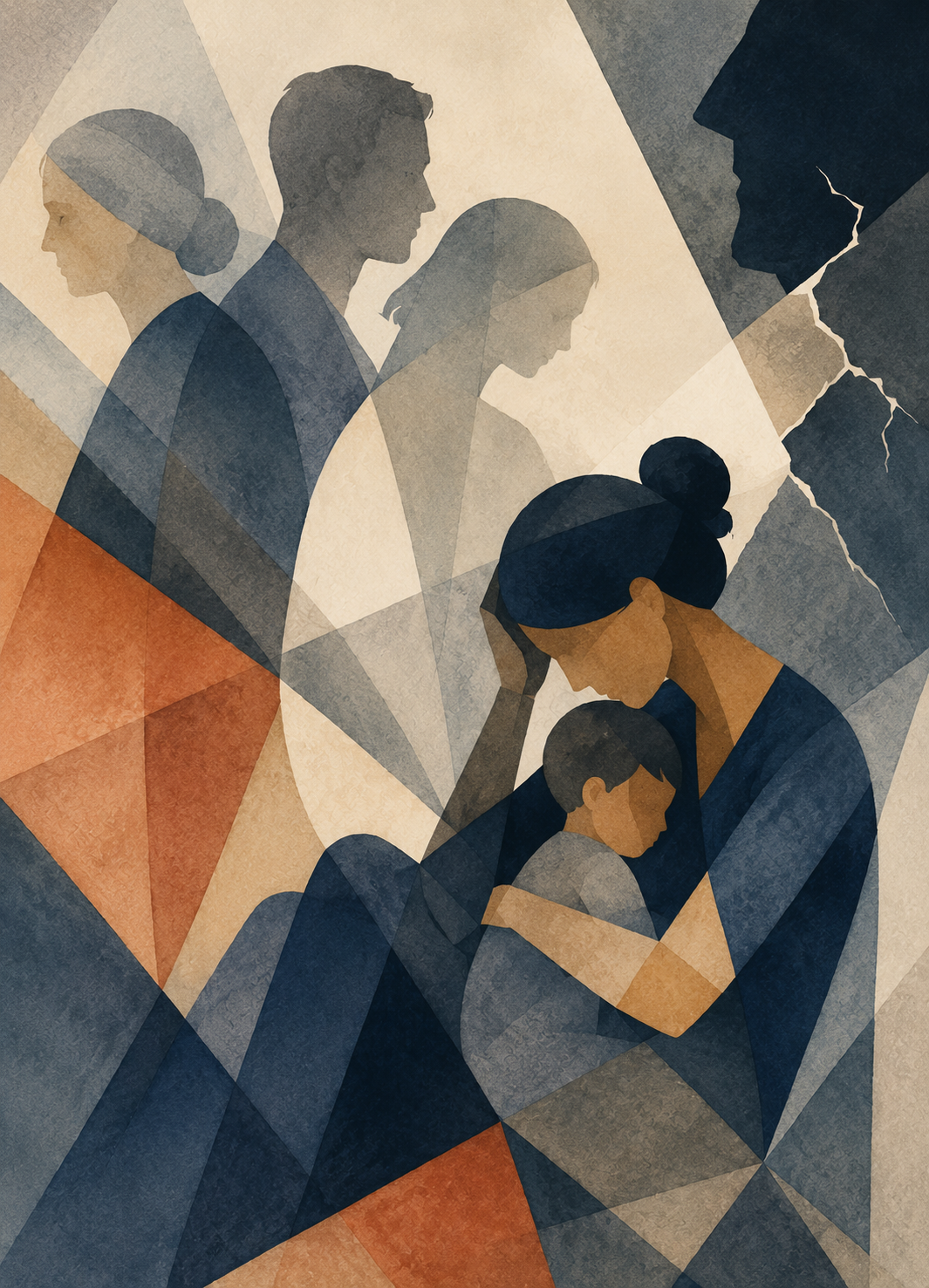

There is a particular kind of dread that sits quietly behind a parent’s eyes — not the worry about whether their child is sleeping enough or eating the right foods, but something deeper and harder to name. It sounds like: “What if I become my parents?” Or: “What if I’m already passing down the very thing I swore I never would?”
In my work as a therapist providing telehealth therapy across multiple states, I hear this fear almost every week — from first-time parents, from couples navigating their first real conflict after a baby arrives, from high-performing professionals who have built successful careers and still feel utterly lost the moment their toddler has a meltdown. If this fear lives in you too, I want you to know: it is not a sign that you are broken. In many ways, it is a sign that healing has already begun.
What Is Intergenerational Trauma?
Intergenerational trauma — sometimes called generational trauma or transgenerational trauma — refers to the transmission of traumatic experiences and their psychological effects from one generation to the next. It is not simply inheriting your parent’s personality quirks or your grandmother’s temper. It is the way that unresolved pain, fear, grief, and survival strategies become woven into the fabric of how a family relates, communicates, protects, and loves.
This transmission happens through multiple pathways. The most studied is behavioral and psychological: parents who carry unresolved trauma pass it on through their parenting styles, emotional availability, attachment behaviors, and family narratives. A parent who grew up learning that emotions were dangerous may struggle to sit with their child’s big feelings. A parent who was never comforted when scared may feel paralyzed — or become critical — when their own child expresses fear.
Research also points to a biological dimension. Studies have found that trauma can leave molecular “tags” on genes through a process called epigenetics, altering how genes are expressed in response to stress. Researcher Rachel Yehuda’s groundbreaking work with Holocaust survivors found that epigenetic changes caused by severe trauma could be observed in both the survivors and their adult children, affecting genes linked to stress response, PTSD, depression, and mood disorders. This does not mean that trauma is an unchangeable destiny written into your DNA — but it does explain why some clients describe an anxiety that feels ancestral, older than their own memories.
The Numbers Behind the Fear
The fear of repeating generational patterns is not unfounded. The Adverse Childhood Experiences (ACE) Study — one of the largest investigations of its kind, conducted by the CDC and Kaiser Permanente with over 17,000 participants — found that almost two-thirds of adults reported at least one ACE, and more than one in five reported three or more. More recent CDC data reveals that emotional abuse was the most commonly reported ACE type (34%), followed by parental separation or divorce (28.4%) and household substance abuse (26.5%).
Perhaps most significant for parents: research consistently shows that parents with higher ACE scores are far more likely to have children with higher ACEs. The cycle perpetuates not because parents are bad people — it perpetuates because unresolved trauma operates below conscious awareness. Without intervention, we tend to parent from our nervous systems, not from our intentions.
The NIMH-funded research led by Dr. Jessica Uy at UCLA found that when mothers experienced childhood neglect or abuse, it negatively impacted their mental health during and after pregnancy, which in turn affected their children’s brain development and mental health. Children surveyed at ages 7-8 showed more feelings of anxiety, depression, and social withdrawal. This research underscores something I witness regularly in my practice: the parenting relationship begins long before a child is born.
Patterns I See in My Practice
Working with individuals and couples navigating this territory, I have noticed several recurring patterns that I want to name clearly — not to pathologize, but to normalize what so many people silently carry.
The Overcorrector
One of the most common presentations I see is what I call the overcorrector: the parent who experienced harshness, rigidity, or emotional neglect in their own upbringing and swings hard in the opposite direction. They become hypervigilant, conflict-avoidant, and exhausted. They never say no, terrified of traumatizing their child. They second-guess every boundary. They google every interaction. And underneath all of that striving is a child-version of themselves who never felt safe and is now working overtime to make sure their child never feels that way.
The problem is that overcorrection creates its own set of difficulties. Research on intergenerational transmission of maternal overprotection has shown that anxious, controlling parenting — even when it comes from love — can contribute to anxiety in children. The nervous system cannot distinguish between “I am being overprotected because my parent is scared” and genuine safety. Children co-regulate with their caregivers; they borrow calm. When a parent’s nervous system is chronically in protection mode, the child’s nervous system learns to be there too.
The Emotionally Shut-Down Parent
The second pattern I see frequently — particularly with my high-performing male clients and clients from cultures where emotional expression was discouraged — is the parent who goes emotionally offline. They love their child fiercely. But when that child is crying, dysregulated, or scared, something in them shuts down. They go cold. They minimize. They say “you’re fine” before the child has finished crying.
This often traces directly to their own attachment history. Attachment theory tells us that the way our caregivers responded to our distress becomes the blueprint for how we respond to distress in others — including our own children. Adults who developed avoidant or dismissing attachment styles often learned that emotional expression was unsafe or unwanted. As parents, these early adaptations can cause them to miss their child’s emotional cues, misinterpret needs, or create distance precisely in the moments when their child most needs to be met.
The Triggered Partner
In couples therapy, some of the most impactful work I do involves helping partners understand that their conflicts are rarely just about the current argument. When one partner shuts down at a raised voice — not because their partner is abusive, but because raised voices were dangerous in their childhood home — that is intergenerational trauma showing up in the marriage. When one partner becomes panicked and clingy the moment their spouse needs space, it often traces to an early experience of abandonment or inconsistent caregiving.
The Gottman Institute’s research and clinical observations reflect what I see every week: adults unconsciously re-enact relational dynamics from childhood in their partnerships. When couples become parents together, these dynamics intensify. Sleep deprivation, identity shifts, new stressors, and the primal weight of being responsible for a small human can crack open wounds that have been carefully managed for years.
The High-Achiever Who Can’t Slow Down
Many of the clients I work with — working professionals, first-generation achievers, immigrants who built lives from hardship — carry a particular brand of generational trauma wrapped in productivity and perfectionism. Their parents survived displacement, discrimination, poverty, or violence. They were taught that achievement was safety. That stopping was dangerous. That vulnerability was weakness.
In parenting, this often looks like a profound difficulty being present without accomplishing something. They show up physically for their child but remain emotionally elsewhere. They push their children toward achievement in ways that mirror — even if softened — the pressure they themselves absorbed. Research on intergenerational trauma in immigrant families documents how survival-oriented parenting strategies, once adaptive, can become sources of disconnection in the next generation. I work with this pattern with immense respect and care, because the root of it is usually profound love and sacrifice.
The Couple Who Cannot Co-Parent
Perhaps the most complex pattern I see is couples who, individually, are thoughtful and self-aware — but the moment they try to make parenting decisions together, collapse into old relational patterns. One partner grew up in a home where authority was absolute; they need control. The other grew up walking on eggshells; they appease rather than engage. These dynamics play out in disagreements about discipline, screen time, or homework help — but what is actually happening is that two different intergenerational legacies are bumping up against each other, each trying to prevent the childhood that felt most threatening.
Why the Fear of “Messing Up” Is So Loud Right Now
We are living in a moment of heightened collective awareness about mental health, generational cycles, and the long-term impact of childhood experiences. This is largely a good thing. But it has also created a generation of parents paralyzed by information — knowing just enough about trauma-informed parenting, attachment theory, and neurological development to feel inadequate at every turn.
What I often gently remind my clients is that the research itself holds hope. Studies on attachment continuity show that parents can and do break cycles of insecure attachment. The intergenerational transmission of trauma is not inevitable. The single most powerful predictor of change is a parent’s capacity for self-reflection — their ability to make sense of their own childhood story rather than simply react from it. This is what therapy builds.
As child psychiatrist Dr. Bruce Perry has noted, our social connectedness is one of the most powerful buffers against stress and distress. When parents do their own healing work — when they develop awareness, language, and new neural pathways — they change the emotional climate of their home in ways that ripple forward.
What Healing Actually Looks Like
Healing intergenerational trauma is not about becoming a perfect parent. It is not about never losing your patience, never raising your voice, or never feeling the pull of old familiar patterns. It is about rupture and repair — and the capacity to come back, acknowledge what happened, and reconnect.
In my work using approaches like Emotionally Focused Therapy (EFT) and Acceptance and Commitment Therapy (ACT), the process often looks like this:
Naming the pattern without shame. We slow down and look at what is actually happening — not just the surface behavior, but the underlying emotion and the story from the past that is driving it. When a parent can say “I shut down because shutting down kept me safe when I was a child — and it doesn’t serve me here,” something shifts.
Building emotional vocabulary. Many adults who grew up in emotionally restricted environments literally lack the internal language to identify what they are feeling. EFT helps clients move from reactive behavior to emotional awareness — recognizing what is happening in the body before it becomes action.
Repairing the couple’s bond. When partners understand that their triggers are not attacks on each other but echoes of older pain, they can become resources for each other’s healing rather than re-traumatizing forces. This is the heart of what I do in couples therapy — helping partners move from conflict and distance to emotional safety and genuine collaboration.
Grieving the childhood you needed. One of the most powerful and often overlooked pieces of this work is grief. Many parents cannot heal the fear of hurting their child until they have grieved the child-version of themselves who was not protected. This is sacred, slow work — and it matters deeply.
A Note to Immigrant and First-Generation Parents
I want to speak directly to those of you whose families came here — or survived here — through extraordinary sacrifice. Your parents or grandparents may have experienced war, persecution, forced migration, or economic hardship that left marks that were never named as trauma. The silence in your family may not have been neglect. It may have been survival. The high expectations placed on you may not have been cruelty. They may have been the language of love available to someone who had lost everything else.
This does not make those patterns harmless in the present. But it does invite a different kind of response than blame — one that holds both the grief of what was missing and the recognition of what was extraordinary about how your family endured. In my practice, this dual lens is central to the healing of immigrant and first-generation couples navigating parenting together.
What You Can Do Right Now
If this article has stirred something in you, I want to offer a few starting points — not as prescriptions, but as invitations:
- Get curious, not critical. When you notice yourself reacting strongly to your child’s behavior, ask: Whose voice is this? Is this response coming from this moment — or from somewhere much older?
- Talk to your partner about your own childhoods. Research shows that understanding your partner’s attachment history reduces reactivity and increases compassion during conflict. You don’t have to have all the answers. You just have to start the conversation.
- Acknowledge the hard moments without catastrophizing them. One difficult interaction does not define you as a parent. The research on what children need most is not perfection — it is a parent who repairs.
- Seek support before the crisis. Therapy is most effective when it is not only a last resort. The patterns that show up in parenting were built over years. They can be changed — and they change faster with skilled support.
You Don’t Have to Figure This Out Alone
The fear of messing up your child is, in most cases, not a sign that you will — it is a sign that you care deeply and that something in you recognizes there is more healing to do. That recognition is not a burden. It is a doorway.
As a therapist specializing in couples and relationships, I work with people doing exactly this work every day: untangling the threads of what was handed to them, building something new for themselves and for the children they love.
Ready to Take the Next Step?
If you recognize yourself in any of these patterns — whether you are parenting solo, navigating this as a couple, or simply sitting with questions you’ve carried for years — I would be honored to be part of your healing journey.
I offer a free 20–30 minute consultation call where we can talk about what you’re experiencing, what you’re hoping to change, and whether working together feels like the right fit.
There is no pressure, no commitment, and no need to have everything figured out before you reach out. Sometimes the most important step is simply deciding that you deserve support.

Dipesh Patel, MBA, MSW, LCSW, LICSW is a couples therapist specializing in Gottman Method Couples Therapy and emotionally focused therapy. He works with high-achieving professionals, the LGBTQ community, first-generation Americans, and multicultural couples navigating relationship stress and life transitions.
Responses
[…] I explore with many fathers is the way their own childhood experiences show up in their parenting. Intergenerational trauma research suggests that parents who carry unresolved trauma may struggle with emotional […]
[…] intuition. A 2022 longitudinal study published in the Journal of Family Issues followed adult children of divorce and found that the quality of the father-child relationship after divorce — shaped […]