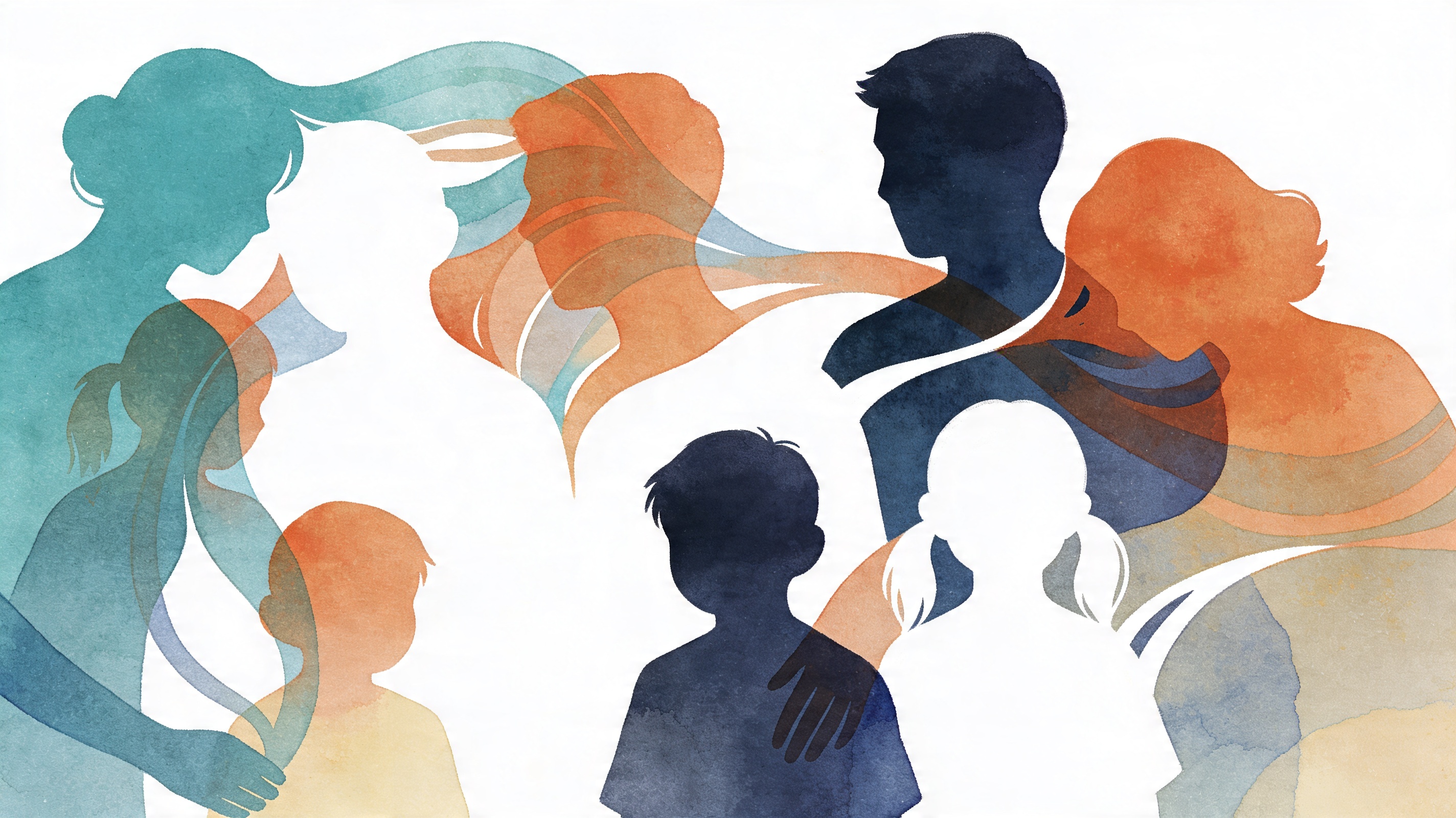

Enmeshment in immigrant families often looks like love, loyalty, and survival on the surface—but inside the therapy room, I see how it can quietly erode boundaries, identity, and intimacy between partners. In couples therapy, it shows up as three people in the relationship: each partner, and the family system that still has a very strong grip on both of them.
What I Mean By “Enmeshment” In Immigrant Families
Clinically, enmeshment is a pattern where family members are overly involved in each other’s emotional lives and boundaries are porous or unclear. In immigrant families, this often exists alongside very real values of collectivism, loyalty, and mutual care, so it can be harder to name without feeling like a betrayal.
Many clients tell me some version of, “In my family, we don’t really have privacy,” or “My parents know everything about our marriage and expect to have a say.” The message is often: there is no clear line between “me” and “us,” and there is certainly no clear line between “us” and “my family.”
I also want to acknowledge something important: research suggests that what looks like “enmeshment” in Western models can sometimes be protective or beneficial in certain cultural contexts, especially when families are less acculturated. Close-knit, highly involved family relationships can support kids’ socioemotional functioning and create a powerful safety net in a new country. So when I work with immigrant couples, I never assume that closeness is unhealthy; I’m always looking at whether the pattern still works for this couple at this stage of life.
Why Enmeshment Is So Common In Immigrant Family Systems
In my office, enmeshment in immigrant families rarely appears out of nowhere. It usually grows out of real historical and cultural conditions that shaped how love and safety were expressed in the first place.
1. Survival mode and shared hardship
Many immigrant parents have lived through war, political violence, economic instability, migration trauma, or chronic discrimination. When a family survives by sticking together, the line between “your feelings” and “my feelings,” or “your life path” and “our life path,” naturally blurs.
I often hear stories like:
- “My parents gave up everything to come here; the least I can do is keep them happy.”
- “We survived by depending on each other. Independence felt like danger, not growth.”
Intergenerational trauma research has shown that the stress and fear of one generation can echo into the next through parenting, family roles, and unspoken emotional rules. In practice, this might look like parents needing a child to be their confidant, rescuer, translator, or proof that their sacrifice was worth it.
2. Acculturation gaps and “living in two worlds”
Children of immigrants often adapt to the new culture faster than their parents: language, norms, dating, boundaries, and mental health concepts all feel more familiar to them. Parents may hold tightly to collectivist values, while their children are moving in and out of more individualistic spaces at school, work, or online.
Researchers call this an “acculturation gap”—a difference in how much each generation has adapted to the host culture—and it can create both conflict and anxiety about losing the family’s values. One way some families cope is by tightening emotional control and expectations:
- “We share everything in this family.”
- “You don’t keep secrets from your parents.”
- “Your decisions are family decisions.”
What looks like enmeshment in the therapy room often began as an attempt to stay connected across cultural and generational divides.
3. Role reversals and parentification
Immigrant kids are often asked to grow up fast. They translate at the doctor’s office, navigate school systems, help with paperwork, manage technology, and sometimes handle bills or legal matters. When emotional support is added to that—comforting a depressed parent, mediating adult conflicts, absorbing family stress—that’s when we start to see enmeshment and parentification.
Clients will say:
- “My mom tells me everything about her marriage.”
- “If my dad is upset, I can’t relax. It’s my job to fix it.”
Over time, these roles can make it hard to know where your responsibility ends and your parent’s begins. That confusion shows up later in romantic relationships.
4. Guilt, obligation, and “good child” identity
In many immigrant families, being a “good child” is not just about behavior—it’s about holding the emotional center of the family steady. Saying no, disagreeing, or setting a boundary can feel like betrayal. Clients often come in with deep guilt for even being in therapy talking about their families.
They say things like:
- “I feel selfish for wanting space.”
- “If I set a boundary, I’m turning my back on my culture.”
This internal conflict keeps enmeshment in place long after someone has moved out, married, or started a life of their own.
How Enmeshment Shows Up Between Partners
By the time I see couples in therapy, enmeshment has usually seeped into the relationship in specific, painful ways. Here are some of the most common patterns I see.
1. “Third parent” in the marriage
One or both partners are still deeply involved in their family of origin’s daily emotional life. Parents weigh in on:
- Money decisions (“You should buy a house near us.”)
- Parenting choices (“We don’t do sleep training; that’s cruel.”)
- Relationship conflict (“You should not let your spouse talk to you like that.”)
It’s not unusual for a parent to call multiple times a day, expect to be updated on every argument, or even insist on being present when the couple makes decisions. The partner who grew up in that system often feels torn: if they push back, they’re “disrespectful”; if they comply, their spouse feels sidelined.
In the room, I hear:
- “It feels like I married you and your mom.”
- “I can’t make any decisions without checking with my parents first.”
2. No private emotional space
Enmeshment often means that personal struggles become family property. When a couple fights, the argument is replayed with parents or siblings. When a partner confides something vulnerable, they fear it will be “reported” back home.
The non‑enmeshed partner may say, “I never know who our business is being shared with.” The enmeshed partner may feel like they’re just following the rule they grew up with: you bring your problems to your family, not to an outsider or a therapist.
This erodes trust and makes it hard to build a sense of “we” inside the couple.
3. Emotional loyalty conflicts
I often see partners torn between their spouse’s needs and their parents’ expectations. Holiday plans, baby names, living arrangements, financial choices—all of these can feel like loyalty tests.
- If they choose their spouse, they feel like a “bad child.”
- If they choose their parents, they feel like a “bad partner.”
Over time, resentment builds on both sides. The spouse feels chronically second place. The enmeshed partner feels constantly judged for not doing “enough” for everyone.
4. Difficulty with boundaries and saying no
Because enmeshment blurs where one person ends and another begins, simple boundaries can feel aggressive. Saying “I need an evening without calls” or “We’d like to make this decision on our own” can feel like a moral failing, not a normal adult limit.
This can spill into the couple dynamic:
- Difficulty saying no to each other.
- Expecting the partner to read minds instead of expressing needs.
- Taking any difference in opinion as rejection rather than just difference.
5. Identity confusion and self‑sacrifice
Many adult children of immigrant families tell me they don’t really know what they want—they know what’s expected of them. Personal decisions about career, where to live, whether to have children, and how to live day‑to‑day were heavily shaped by family needs and narratives.
In couples therapy, this can look like:
- Choosing a partner in part to please (or defy) the family.
- Struggling to articulate personal preferences in the relationship.
- Feeling guilty for wanting a life that doesn’t fully center the family of origin.
One partner may feel like they are always “disappearing” into family obligations. The other may feel like they are “dragging” their partner away from the people who raised them.
What I See In The Therapy Room
When immigrant couples come to therapy with enmeshment issues, the themes are remarkably consistent, even across very different cultures and stories.
The overwhelmed partner
One partner—often the one who didn’t grow up in an enmeshed or immigrant family—comes in feeling overwhelmed, shut out, and sometimes deeply resentful. In their words:
- “I feel like we’re always on call for your family.”
- “We never make decisions without your parents’ input.”
- “I don’t feel like our relationship is the priority.”
They may fantasize about moving far away, changing phone numbers, or setting very firm boundaries, but they feel like the “villain” for wanting that.
The torn partner
The other partner is often caught in the middle. They may fully see the problem but feel paralyzed about what to do. Their internal monologue often sounds like:
- “My parents gave up everything. How can I say no?”
- “If I put my marriage first, I’m betraying my family.”
- “If I put my family first, I’m losing my partner.”
They might defend their parents in session, not because they don’t see the impact, but because naming the impact feels disloyal. Underneath, there is usually a deep fear of abandonment—by their partner, by their parents, or both.
The quiet grief
Underneath the fights about phone calls, holidays, and money, there is often grief:
- Grief for the childhood that felt heavy with adult responsibilities.
- Grief for the parents who never got to feel safe enough to loosen control.
- Grief for the version of the relationship that might have been possible with fewer people involved.
Part of the work is making room for that grief, not just jumping to solutions.
How We Work Through Enmeshment In Couples Therapy
When I work with enmeshment in immigrant families, I’m not trying to “Westernize” anyone’s family values. I’m trying to help couples choose, consciously, which parts of their cultural inheritance they want to keep and which patterns they’re ready to update.
1. Naming the pattern with cultural respect
We start by naming what’s happening without attacking anyone’s parents or culture. I might say:
- “It sounds like your family’s way of loving has been to be very involved and very close. That closeness helped you all survive a lot. And now it may be colliding with what your marriage needs in this season.”
I also share that research shows enmeshment in some immigrant families can be protective and beneficial in certain contexts; the goal is not to pathologize closeness but to ask: is this pattern still working for you now?
This framing makes it easier for clients to explore change without feeling like they’re “turning their back” on where they come from.
2. Exploring family roles and stories
We often map out each partner’s family system: who did you go to for comfort, who did you protect, who depended on you, what were the spoken and unspoken rules. We might identify roles like:
- The peacekeeper.
- The responsible oldest child.
- The emotional spouse to a lonely parent.
Connecting those roles to current behaviors (“No wonder you feel responsible for everyone’s emotions”) helps clients have compassion for themselves instead of just shame or frustration.
We also look at intergenerational trauma—migration stories, losses, discrimination—and how those realities shaped family rules about closeness, privacy, and loyalty.
3. Differentiating between “respect” and “fusion”
A big part of the work is teasing apart respect from fusion. Respect might look like:
- Speaking kindly.
- Listening to elders’ perspectives.
- Helping out within your capacity.
Fusion looks more like:
- Feeling unable to make adult decisions without parental approval.
- Sharing your partner’s private information to manage parental emotions.
- Collapsing your needs to prevent family guilt or anger.
We talk explicitly about the idea that setting boundaries can be a form of respect—of your parents’ humanity, your partner’s humanity, and your own.
4. Building an inner “permission” to individuate
Many adult children of immigrants don’t feel they have internal permission to be separate people. In therapy, we work on that inner permission before we even talk about concrete boundaries. That might involve:
- Identifying and challenging core beliefs like “Good children don’t say no” or “My worth depends on my parents’ happiness.”
- Practicing imagining a life where both family connection and personal autonomy exist side by side.
- Exploring how their parents’ lack of safety growing up may be influencing their need to keep control now.
This part is often slow and emotional. It’s not about cutting off; it’s about allowing new possibilities to even be thinkable.
5. Co‑creating couple boundaries
Once there is some shared understanding, we begin to design boundaries together as a couple. Not “your boundaries vs. my boundaries,” but “our boundaries as a team.” For example:
- How many times a day is it reasonable to answer family calls?
- What topics are off‑limits for family involvement (e.g., sex life, conflicts)?
- How will we handle disagreements about holidays, money, childcare?
We practice scripts that honor culture and care while still setting limits, such as:
- “We love how involved you are in our lives, and we also want to practice making some decisions on our own as a couple.”
- “I appreciate your advice, and we’re going to try it our way first and see how it goes.”
The non‑enmeshed partner also does work here: learning to express needs without contempt, and recognizing that change may feel genuinely scary for their spouse.
6. Preparing for and tolerating pushback
Most families don’t respond to new boundaries with immediate gratitude. There may be guilt, anger, tears, or escalating pressure. We prepare for this reaction together in session:
- “If your mother cries, what will you say?”
- “If your father threatens to stop talking to you, how will you ground yourself in your values?”
We talk about how pushback doesn’t necessarily mean you’re doing something wrong; it often means you’re changing a long‑standing pattern.
Sometimes we also work with the idea that parents, too, have their own histories of enmeshment, trauma, and lack of modeling around boundaries. That doesn’t excuse harmful behavior, but it can soften some of the resentment and make it easier to stay firm and compassionate.
7. Strengthening the couple’s bond
As boundaries shift, the couple often feels both relief and new anxiety: “Now that my family isn’t in everything…who are we?” We spend time actually building the couple identity:
- Rituals, shared values, and private jokes that belong just to them.
- Clear agreements about communication, conflict, and support.
- Space to disagree without feeling like someone’s parents need to step in and referee.
When their own relationship feels more solid, it becomes easier to negotiate with extended family from a place of groundedness instead of fear.
Takeaways If You Recognize Yourself Here
If any of this sounds familiar, here are some important ideas to hold onto.
1. You’re not “crazy” or “ungrateful” for feeling trapped
If you grew up in an enmeshed immigrant family, it makes sense that you might feel guilty for wanting space and at the same time suffocated by constant involvement. Both can be true. Your love for your family does not cancel out your need for psychological room to breathe.
2. Closeness and boundaries can coexist
You do not have to choose between being a “good child” and having a healthy adult life. Boundaries are not rejection; they’re the structure that allows relationships to survive over time without collapsing into resentment and burnout.
3. Your parents’ trauma doesn’t have to be your template
Intergenerational trauma is real, and it can shape how families do attachment, control, and emotional expression. But it is possible to honor what your parents went through while still choosing a different way of relating in your own home. You don’t heal trauma by reenacting it; you heal it by doing something new.
4. Your partnership deserves its own “center of gravity”
If you’re in a relationship, it deserves to be its own center—not eclipsed by any outside system, even a beloved family. That doesn’t mean cutting off contact; it means giving your partnership enough privacy, loyalty, and priority to grow.
5. This work is hard—and you don’t have to do it alone
Unraveling enmeshment, especially in an immigrant context, is not a quick boundary script or a one‑time conversation. It is deep, identity‑level work that touches culture, history, grief, and love. It’s work you deserve support for.
If you and your partner are struggling with enmeshment in your families of origin, couples therapy can be a space where all of this complexity is welcome—where we can honor your parents’ sacrifices and still help you build a life that feels like your own.
When you imagine setting even one small boundary with family—like delaying a call, keeping one issue just between the two of you, or making a decision without asking for approval—what feelings come up first: guilt, fear, relief, or something else?
If you and your partner are stuck or are experiencing similar things, I invite you to reach out to schedule a free 20-30 mins consultation and take the next step toward a more connected, supported relationship.

Dipesh Patel, MBA, MSW, LCSW, LICSW is a couples therapist specializing in Gottman Method Couples Therapy and emotionally focused therapy. He works with high-achieving professionals, the LGBTQ community, first-generation Americans, and multicultural couples navigating relationship stress and life transitions.
Responses
[…] core part of my work is helping couples reframe the decision away from which family gets more access and toward what their relationship, as its own unit, needs to […]
[…] on immigrant youth shows a tension between family obligation (feeling responsible for parents’ well‑being and honor) and individuation (developing a […]