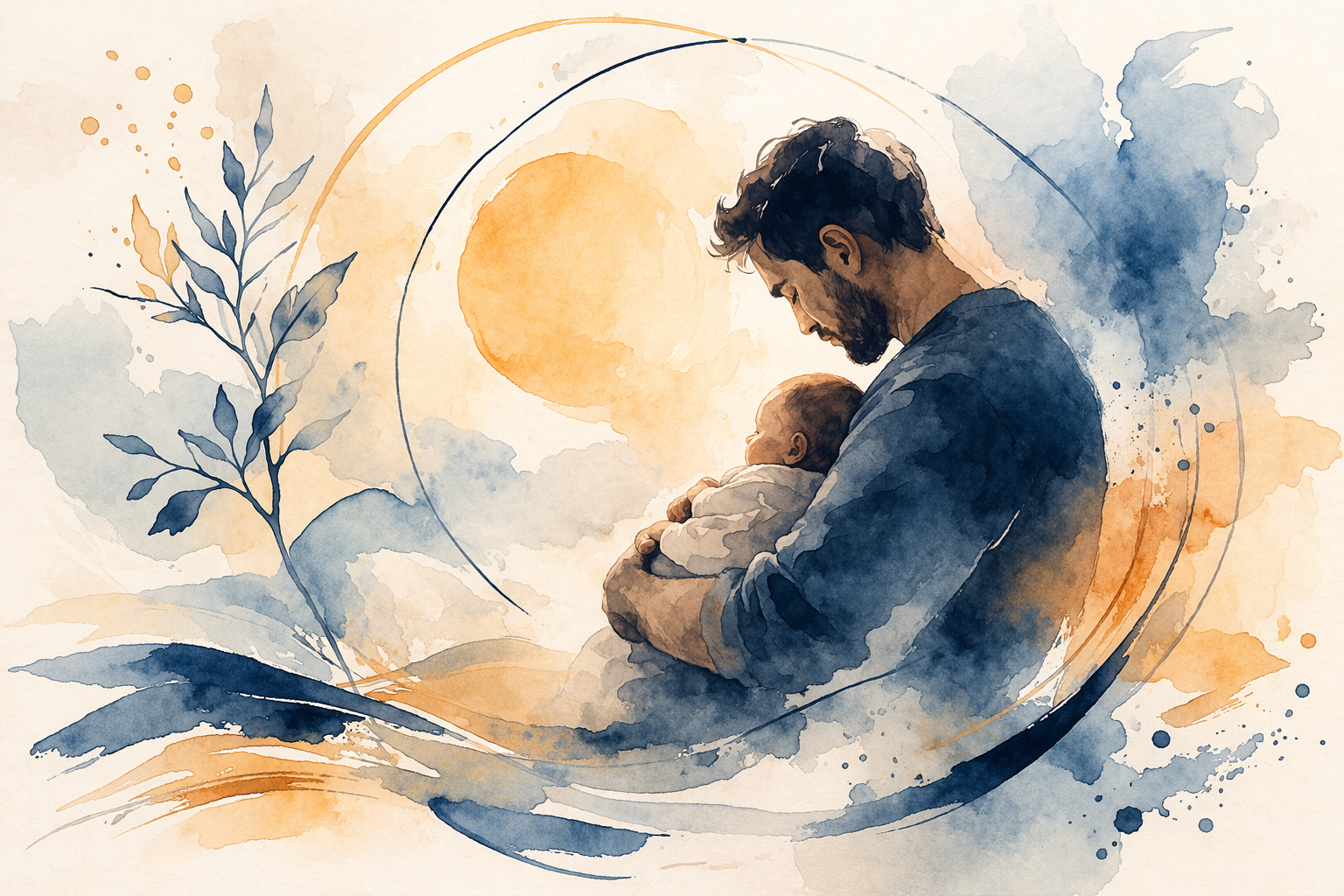

The first year of fatherhood is often described in simple terms: joy, responsibility, exhaustion. But clinically—and relationally—it’s far more complex than that.
For many men, this period isn’t just an adjustment. It’s an identity shift, a psychological reorganization, and in some cases, a mental health crisis that goes largely unrecognized.
We’ve built entire systems around supporting mothers in the perinatal period—and rightfully so. But fathers often enter this same transition without a roadmap, without language, and without much permission to struggle.
Simply put: the first year of fatherhood changes men.
And when that change isn’t understood, supported, or processed—it often shows up in ways that don’t look like “mental health” at all.
The Hidden Reality: Fathers Struggle More Than We Talk About
Let’s start with what the research actually tells us.
- Around 8–13% of fathers experience postpartum depression.
- Roughly 1 in 10 dads experience depression or anxiety in the first year.
- Some studies suggest rates may climb as high as 25% in first-time fathers.
- Risk for depression and stress disorders can increase later in the first year—not just immediately after birth.
That last point is critical.
Most people assume the hardest part is the newborn phase. But clinically, we often see something different: the delayed crash.
Early on, fathers are running on adrenaline—problem-solving, supporting their partner, adapting to chaos. But as the months go on, the reality sets in:
- Sleep deprivation becomes chronic
- Relationship dynamics shift
- Financial pressure becomes more real
- Identity questions deepen
And that’s when symptoms often emerge.
Why the First Year Hits Fathers So Hard
1. Identity Disruption (That No One Prepares You For)
Becoming a father isn’t just adding a role—it reshapes how you see yourself.
Men often move from:
- Independent → responsible for another life
- Partner → co-parent
- Individual identity → provider/protector
But here’s the problem: there’s rarely space to process that shift.
Many fathers don’t consciously say:
“I feel like I don’t know who I am anymore.”
Instead, it shows up as:
- Irritability
- Withdrawal
- Overworking
- Emotional numbness
Research shows paternal depression can include restricted emotional expression and irritability, rather than classic sadness.
So it often gets missed.
2. Emotional Suppression and Social Conditioning
Most men weren’t taught how to process vulnerability in real time.
They were taught to:
- Handle it
- Push through
- Stay strong
And fatherhood amplifies this.
Because now there’s an unspoken belief:
“I don’t get to struggle. My job is to support everyone else.”
This creates a dangerous dynamic:
- Emotional distress increases
- Expression decreases
- Internal pressure builds
Over time, that gap becomes unsustainable.
3. Relationship Strain (Even in Strong Couples)
The first year of parenthood is one of the highest-risk periods for relationship distress.
Even healthy couples experience:
- Less time together
- More conflict
- Reduced intimacy
- Increased miscommunication
And here’s where it becomes clinically important:
When the mother is struggling with postpartum mental health, the father’s risk of depression increases significantly .
Mental health becomes relational—not individual.
You don’t just have one person struggling.
You have a system under stress.
4. The Pressure to “Provide” Intensifies
Fatherhood often activates a deep, internalized pressure:
“I need to step up financially.”
This can lead to:
- Working longer hours
- Avoiding time at home
- Increased anxiety about money
- Chronic stress
But here’s the paradox:
The more a father leans into work to manage pressure,
the more disconnected he may feel at home.
Which then creates:
- Guilt
- Distance from partner
- Reduced bonding with the child
And that loop reinforces itself.
5. Sleep Deprivation and Cognitive Impact
Sleep deprivation isn’t just tiring—it’s destabilizing.
Chronic sleep disruption is associated with:
- Mood dysregulation
- Increased irritability
- Poor decision-making
- Higher risk of depression
And unlike short-term stress, this isn’t a few bad nights.
It’s months.
That cumulative effect changes how fathers think, feel, and respond.
What Paternal Mental Health Actually Looks Like
One of the biggest reasons fathers don’t get support is simple:
Their symptoms don’t look the way people expect.
Instead of sadness, you often see:
1. Irritability and Anger
- Short temper
- Frustration over small things
- Feeling constantly “on edge”
2. Emotional Withdrawal
- Pulling away from partner
- Reduced communication
- Feeling disconnected from the baby
3. Numbing or Avoidance
- Excessive screen time
- Overworking
- Substance use
4. Anxiety Disguised as Control
- Hyper-focus on routines or finances
- Difficulty relaxing
- Constant sense of pressure
5. Shame and Self-Doubt
- “I should be handling this better”
- “Other dads don’t struggle like this”
- “Something’s wrong with me”
Clinically, this is where many fathers get misread.
They’re not disengaged, but rather overwhelmed.
The Timeline: Why Symptoms Often Peak Later
One of the most misunderstood aspects of paternal mental health:
It doesn’t always show up right away.
Research shows depression in fathers can emerge anytime within the first year postpartum.
And in many cases, it peaks:
- Around 3–6 months
- Or even closer to 9–12 months
Why?
Because early survival mode eventually gives way to reality:
- The “temporary phase” isn’t temporary
- Fatigue accumulates
- Relationship strain becomes clearer
- Personal needs remain unmet
That’s when the system starts to break down.
The Impact on Relationships and Children
This isn’t just about the father.
Paternal mental health has measurable ripple effects:
- It can affect child emotional and behavioral development
- It influences partner relationship quality
- It shapes early attachment patterns
When fathers are emotionally available, children benefit.
When fathers are overwhelmed or withdrawn,
that absence is felt—even if it’s subtle.
Why Fathers Don’t Seek Help
This is where things become both clinical and cultural.
I’ve seen this happen in many ways working with clients and couples, but fathers often don’t seek help because:
1. They Don’t Recognize It as Mental Health
They think:
- “I’m just stressed”
- “This is normal”
2. It Doesn’t Match the “Depression” Narrative
No sadness → no problem (in their mind)
3. Stigma
There’s still a strong belief:
“Men shouldn’t need help.”
4. Lack of Screening
There are no consistent guidelines for screening fathers for postpartum depression
So the system doesn’t catch it.
What Actually Helps (Clinically and Practically)
This is where therapy—and structured support—makes a difference.
Not just talking.
But targeted, intentional intervention.
1. Naming What’s Happening
The first shift is simple but powerful:
Helping fathers understand:
“This isn’t failure. This is a known transition with predictable stressors.”
That alone reduces shame.
2. Rebuilding Emotional Awareness
Most fathers don’t need more advice.
They need help:
- Identifying what they’re feeling
- Understanding why
- Expressing it without shutting down
This is where approaches like EFT are powerful.
3. Creating Structure (Not Just Insight)
Simply understanding the problem isn’t enough.
Fathers benefit from:
- Clear communication tools
- Defined roles in parenting
- Actionable strategies for stress
This is where structured methods—like Gottman—come in.
4. Strengthening the Couple System
Because fatherhood doesn’t happen in isolation.
When couples:
- Improve communication
- Reduce conflict
- Support each other emotionally
Both partners’ mental health improves.
5. Addressing Lifestyle Factors
This often gets overlooked, but it matters:
- Sleep strategies
- Work boundaries
- Social connection
- Time for recovery
Mental health isn’t just internal.
It’s environmental.
A Clinical Reality Most People Miss
Here’s what stands out most in practice:
Many fathers don’t come in saying:
“I’m struggling with mental health.”
They come in saying:
- “We keep arguing”
- “I feel disconnected from my partner”
- “I don’t feel like myself anymore”
Mental health shows up through the relationship.
And when you address the system,
you often resolve the symptoms.
The Bigger Shift We Need
If we zoom out, this isn’t just an individual issue.
It’s a systemic gap.
We’ve normalized:
- Maternal mental health support
- Postpartum screening
- Open conversations about motherhood struggles
We haven’t done the same for fathers.
And until we do, many men will continue to struggle silently in one of the most important transitions of their lives.
Final Thoughts
The first year of fatherhood is not just about learning how to care for a child.
Some fathers navigate this smoothly.
Many don’t.
And when they don’t, it doesn’t mean they’re failing.
It means they’re going through something real—something that deserves attention, structure, and support.
If the first year of fatherhood has felt heavier than expected—more pressure, more distance, more frustration than you thought it would—this is exactly where the work begins. You don’t have to figure it out alone; a focused 15–30 minute consultation can help you understand what’s happening and what to do next.
Whether individually or as a couple, this work is about creating real movement—so you’re not just getting through this phase, but actually building a stronger, more connected version of your life and relationship.

Dipesh Patel, MBA, MSW, LCSW, LICSW is a couples therapist specializing in Gottman Method Couples Therapy and emotionally focused therapy. He works with high-achieving professionals, the LGBTQ community, first-generation Americans, and multicultural couples navigating relationship stress and life transitions.
Talk it through in a free 15–30 min consultation—no pressure, just clarity.


Response
[…] therapy, I help clients understand where their vigilance comes from, whether it is serving them or depleting them, and how to build genuine rest into a nervous system that has learned not to trust rest. In couples […]