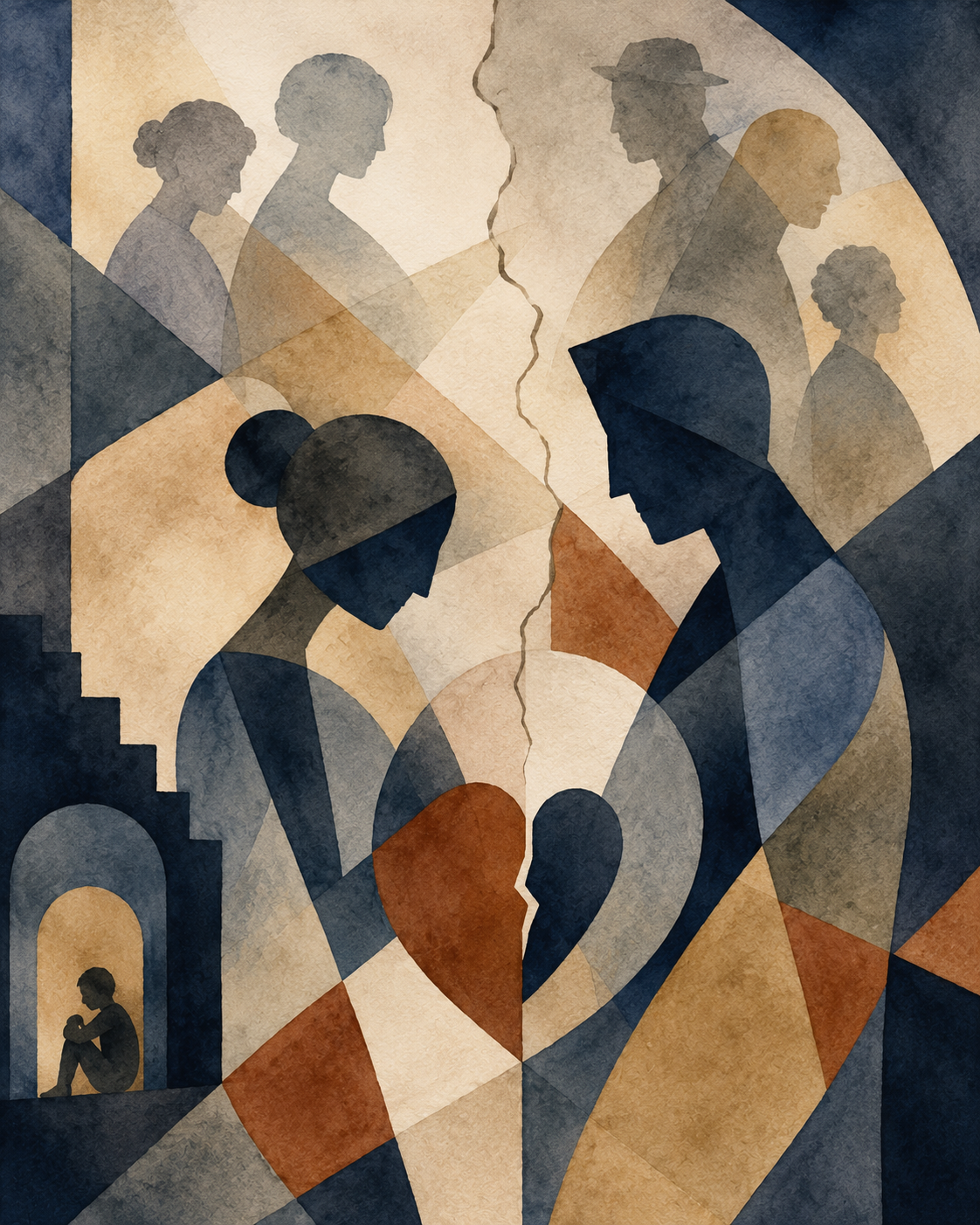
As a couples and individual therapist working with high‑performing professionals, I see the same quiet pattern over and over: people carefully select partners who, on paper, “look” right—successful, responsible, attractive—but feel disturbingly familiar in the emotional texture of the relationship.
Many of my clients say variations of the same thing:
“I keep dating people who are emotionally distant.”
“Every relationship ends the way my parents’ did.”
“I picked someone who treats me like my dad did.”
What they’re describing is often generational trauma at work: the unconscious pull toward partners who mirror family roles, relational patterns, or emotional climates from childhood.
This article explores how generational (or intergenerational) trauma shapes our dating choices, the patterns I see most often in my practice, and how therapy can help you choose partners who actually support your healing instead of re‑enacting the past.
What Is Generational Trauma?
Generational trauma—also called intergenerational or transgenerational trauma—refers to psychological and emotional wounds that pass from one generation to the next, even when the later generation did not directly experience the original trauma.
Trauma can be passed down through:
- Repeated family stories (and the silences around them)
- Caregiving behaviors (how parents soothe, punish, or withdraw)
- Attachment patterns (who is “favored,” who is blamed, who is groomed as the peacekeeper)
- Unspoken rules about emotions, success, love, and conflict
Relational trauma—such as chronic invalidation, inconsistent parenting, emotional neglect, or intimate‑partner violence—doesn’t just shape a single person; it echoes through relationships, parenting styles, and even how children grow up to choose romantic partners.
From a clinical perspective, generational trauma doesn’t show up in one dramatic script; it lives in the background music of a family: the tone of arguments, the way conflict is avoided, how much affection is allowed, and what “love” is allowed to look like.
Why We “Pick The Same Type” (Even When We Say We Won’t)
Generational trauma doesn’t usually feel like a conscious choice. It feels like “chemistry,” “vibe,” or “just how things happened.”
Clinically, this is often explained by:
- Repetition compulsion: the unconscious drive to re‑play unresolved emotional scenes from childhood in the hope of mastering them this time.
- Familiarity bias: the nervous system trusts what it already knows, even if it’s painful.
- Attachment imprinting: early attachment experiences shape core expectations about safety, rejection, and care.
When early caregivers were emotionally inconsistent, critical, or absent, the child’s brain learns that “love feels uncertain” or “I have to perform to be safe.” That imprinted template can be carried into adulthood and used as a filter for dating—who feels “right” may be anyone who vaguely matches that script.
How Generational Trauma Quietly Steers Your Dating Choices
Below are some of the most common ways I see generational trauma show up in my practice, across heterosexual, same‑sex, and cross‑cultural couples.
1. Being Drawn To “Emotionally Unavailable” Partners
One of the most frequent patterns is repeatedly choosing partners who are emotionally distant, preoccupied, or slow to reassure. From the outside, this can look like “bad taste” or “poor boundary setting,” but under the surface, it often mirrors caregivers who were:
- Physically present but emotionally absent
- Overwhelmed by their own stress
- Discouraging emotional expression
A child raised in this environment learns that love is not safe to fully reach toward. As an adult, they may unconsciously seek partners who recreate that dynamic, because full emotional availability feels unfamiliar or even threatening.
In session, I often help clients notice:
- Where they feel “nervous” when a partner is too warm or invested
- When they pull away around certain kinds of vulnerability
- How quickly they assume they’ll be disappointed or let down
2. Choosing Partners Who Trigger Childhood Criticism Or Shame
Another common pattern is partners who echo a critical parent, sibling, or extended‑family voice. Clients tell me things like:
- “My partner reminds me of my mom: always scrutinizing my choices.”
- “He talks to me the way my dad talked to me when I was a kid.”
When criticism, sarcasm, or conditional approval were central to how care was delivered, the nervous system can begin to associate love with evaluation.
In therapy, people often discover that they’re more comfortable with partners who:
- Evaluate them (even harshly)
- Set high performance standards
- Make love feel “earned” rather than freely given
This isn’t about masochism; it’s about what the brain has learned to expect from connection. Generational trauma can make self‑worth feel fragile, so being “good enough for love” becomes a constant, exhausting project.
3. Repeating Parental Roles (The Peacekeeper, The Responsible One, The Golden Child)
In families shaped by trauma, children often adopt roles that help the system survive:
- The peacekeeper who calms conflicts
- The caregiver who looks after emotionally fragile parents
- The *high‑achieving’ one whose success is the family’s pride
- The *invisible’ one kept out of the chaos
Generational trauma can cause people to unconsciously choose partners who slot them back into these roles. For example:
- A lifelong peacekeeper may date partners who are emotionally volatile, so they’re “needed” to manage the tension.
- A “responsible” child may pick partners who are disorganized, financially unstable, or emotionally dependent, so they can replay the caretaker role.
In couples work, we often trace how these family roles map onto current relationship dynamics: who is expected to apologize, who keeps the peace, who manages logistics, and who “gets to be” fragile.
4. Being Attracted To “Familiar Chaos” (Conflict, Drama, Intensity)
Some clients are drawn to partners who:
- Create frequent arguments
- Are emotionally intense
- Oscillate between passion and withdrawal
On the surface, this can look like “relationship drama,” but clinically it often reflects a family history where:
- Conflict was unpredictable or explosive
- Love and anger were intertwined
- Silence between outbursts became the only way to feel “safe”
Generational trauma can make calmness feel empty or suspicious, while emotional intensity feels like being “seen.” My job then becomes helping clients differentiate between “connection” and “adrenaline,” and to notice when they feel calm in a relationship is experienced as “boring” or “not engaged.”
5. Avoiding “Safe” Partners Because They Feel “Boring” Or “Too Nice”
On the flip side, many clients tell me they’ve dated kind, stable people but “couldn’t feel excited” or “fell out of love.” They end up returning to partners who are more emotionally risky.
Generational trauma can make consistent safety feel unfamiliar or even dull. If early childhood featured unpredictability, inconsistency, or high stakes, the nervous system may associate “safe” with “uninteresting” or “unloving.”
In therapy, we explore:
- What “safe” actually feels like in the body
- When comfort is mistaken for disconnection
- Whether the craving for intensity is a survival strategy, not a lifestyle preference
How Generational Trauma Shows Up In Couples Relationships
Generational trauma doesn’t just shape who we choose; it shapes how couples function together. In my work with individuals and couples, I see several recurring themes:
It Fuels Invisible Conflict Scripts
Couples often replay arguments that mirror family conflicts. For example:
- One partner sounds like their mother, the other like their father.
- A pattern of one person withdrawing while the other pursues echoes how caregivers handled conflict.
These patterns feel automatic because they’re rooted in family‑of‑origin scripts. Generational trauma can turn “communication issues” into “re‑enactments” of unresolved family dynamics.
It Shapes Who Gets To Be Vulnerable
In families shaped by trauma, some people learn that vulnerability leads to ridicule, punishment, or abandonment, while others learn that vulnerability is manipulative or “too much.” This shows up in couples through:
- One partner who avoids emotional disclosure
- One partner who feels “too needy” when they ask for reassurance
- An unspoken hierarchy where one person’s emotions are prioritized over the other’s
Trauma‑informed therapy helps couples notice whose fears of exposure were shaped by family history and whose fears of engulfment were shaped by being over‑responsible for others.
It Influences How You Define Love
Generational trauma can embed messages such as:
- “Love is sacrifice.”
- “If you’re loved, you’ll be controlled.”
- “If you’re loved, you’ll be criticized.”
These beliefs become filters for dating. Partners who respect boundaries may feel “distant,” while partners who monitor or control behavior may feel “protective.” Therapy helps clients unpack these inherited beliefs and rewrite what love is allowed to look like.
What The Research Says About Generational Trauma And Relationships
Psychology and neuroscience increasingly support the idea that trauma and relational patterns move across generations.
- Attachment theory explains how early caregiving shapes expectations of closeness, trust, and conflict in adult relationships.
- Intergenerational trauma research shows that children of trauma survivors can experience higher rates of anxiety, depression, and relational difficulties, even when they did not witness the original trauma directly.
- Family systems theory emphasizes how roles, secrets, and unspoken rules get passed down, shaping how people relate to each other across generations.
Clinically, this means that when clients ask, “Why do I keep choosing this type of partner?” the answer often lies not in their “bad judgment,” but in their family ecosystem and the way their nervous system learned to survive it.
Do You See These Patterns In Your Own Dating History?
Consider reflecting on questions from my clinical work:
- Do your partners tend to be emotionally unavailable, inconsistent, or sharply critical in similar ways?
- Do you often feel like you’re “managing” your partner’s emotions or family issues?
- Do you notice that you are attracted to people who remind you of a parent, sibling, or caregiver?
- Do stable, kind partners feel “boring” or “too low‑maintenance” to you?
If you see strong patterns like these, generational trauma may be influencing your dating choices more than you realize. Recognizing this is not about blaming your family; it’s about taking responsibility for your own relational future.
How Therapy Helps Break The Cycle
As a therapist who works with both individuals and couples, I use a few key approaches to help clients untangle generational trauma from their dating choices.
1. Mapping Your Family System
We often start by creating a genogram or “family map” together:
- Who was emotionally available or absent?
- Who was the peacekeeper, the black sheep, or the over‑responsible one?
- What was modeled about conflict, affection, and boundaries?
This helps us see where your current preferences and discomforts originate.
2. Naming Repetition Patterns
In session, we track patterns across your relationships:
- Who tends to be the “pursuer,” who the “distancer”?
- How quickly do you feel criticized or inadequate?
- What kinds of conflict scripts keep repeating?
Naming these patterns helps move them from the background of the nervous system into conscious awareness.
3. Rewiring Attachment Expectations
Through attachment‑focused work and somatic awareness, we:
- Identify when your body responds to a partner as if they were a parent.
- Practice responding to fear and insecurity differently than your family did.
- Learn to tolerate emotional safety without treating it as “boring” or suspicious.
This doesn’t mean undoing your past; it means creating new neural pathways for how you experience love.
4. Choosing Partners With Intention, Not Just Familiarity
Instead of simply “hoping” to choose differently, we build a set of criteria grounded in your values:
- What does emotional safety actually need to feel like?
- How do you want to be spoken to during conflict?
- What kind of care do you refuse to accept anymore?
With this clarity, dating becomes less about “chemistry” and more about compatibility with your healing.
You Don’t Have To Repeat What You Inherited
Generational trauma is powerful because it operates quietly, under the radar of conscious choice. It shapes who feels “right” before you’ve even met someone, and it can make you feel like you’re “failing” at love when, in reality, you’re just repeating a hidden script.
The good news is that patterns learned across generations can be updated in one lifetime. Through therapy, self‑reflection, and intentional dating, you can:
- Recognize where your family history is living in your choices
- Release the obligation to replay old roles
- Choose partners who support your growth, not your wounds
If you’re noticing that your dating history keeps echoing the same themes—emotional distance, criticism, drama, or people who remind you of your family—this is a strong signal that working with a trauma‑informed therapist can make a real difference.
Ready To Understand How Generational Trauma Shapes Your Love Life?
If you’re tired of dating people who feel familiar but not nurturing, and you’re ready to explore how your family history might be guiding your choices, I invite you to take the next step.
As a licensed couples and individual therapist working across multiple states via telehealth, I offer a free 20–30 minute consultation call to help you:
- Identify patterns in your dating history
- Clarify whether generational trauma might be influencing your choices
- Explore whether my approach aligns with your goals
During this call, there’s no pressure to commit to ongoing therapy. It’s simply a space to ask questions, share what you’re noticing, and begin envisioning a different kind of relationship pattern.
Click the link below or submit the contact form on this site to request your free 20–30 minute consultation call, and we’ll schedule a time that fits your professional schedule.
Because healing generational trauma in your love life doesn’t have to start with a big confession to your partner—it can start with a quiet, brave conversation with yourself and a therapist who understands how your family history shapes who you choose to date.

Dipesh Patel, MBA, MSW, LCSW, LICSW is an individual and couples therapist specializing in Gottman Method Couples Therapy, Emotionally Focused Therapy, and Acceptance and Commitment Therapy. He works with high-achieving professionals, new and seasoned parents, the LGBTQ community, first-generation Americans, and multicultural couples navigating relationship stress and life transitions.
Response
[…] inherently less stable or less “real” than straight relationships. This belief can stem from cultural narratives, family messages, or religious teachings that portray same-gender relationships as temporary, […]