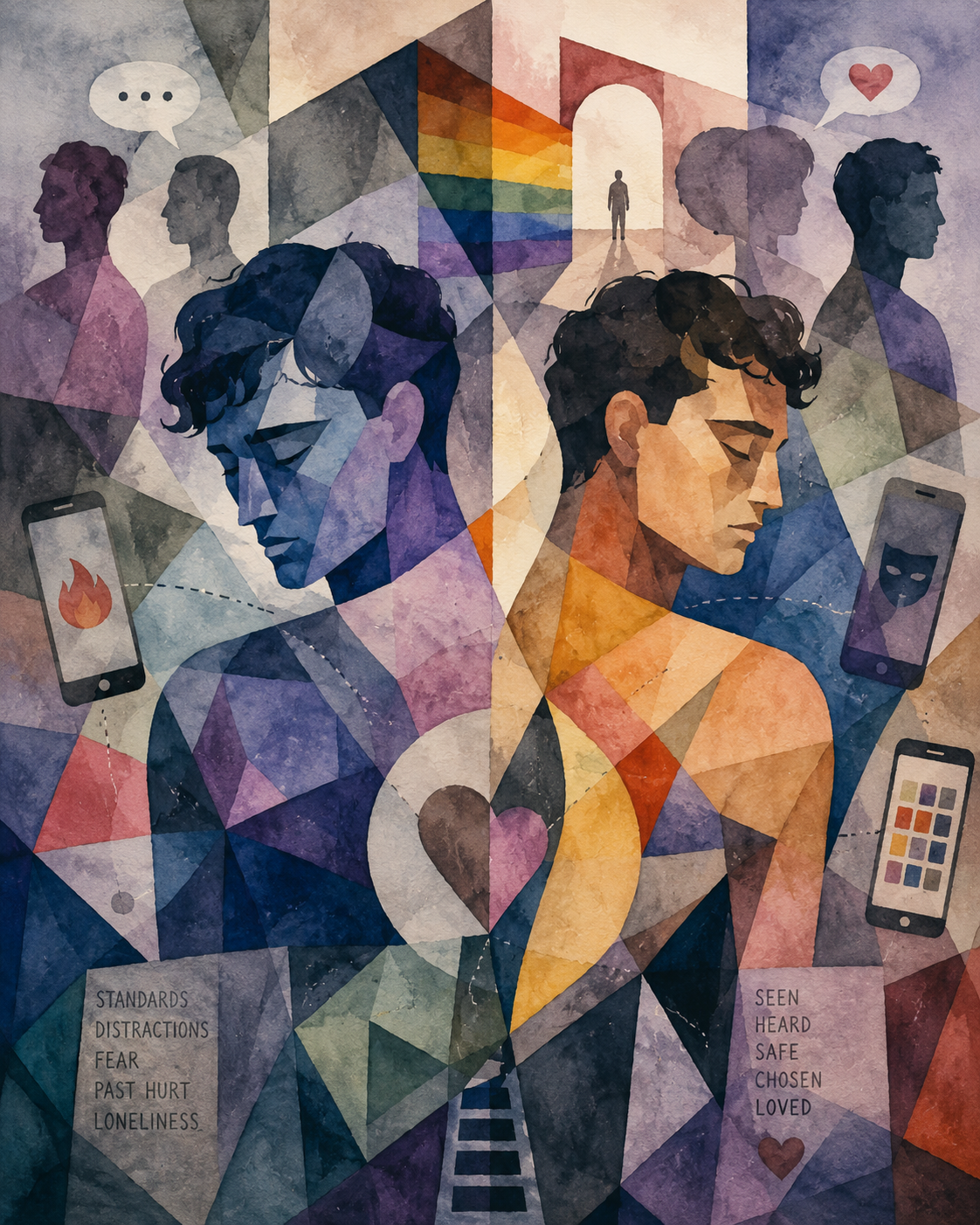
Genuine connection in LGBTQ dating often feels hard to find because so many queer people are dating while also carrying minority stress, past hurt, and confusing messages about love, worth, and visibility in a digital-first world. As a queer-affirming therapist working with individuals and couples, I see the same patterns and pain points surface again and again beneath the “no one wants anything real” feeling.
The Hidden Weight Behind “Why Is This So Hard?”
When LGBTQ clients tell me “I can’t find anything real,” they’re usually talking about much more than bad dates. They’re describing the cumulative impact of stigma, rejection, and chronic uncertainty on their nervous system, attachment patterns, and sense of self.
Research shows LGBTQ people face elevated rates of minority stress and discrimination, which are strongly linked to anxiety, depression, and relational difficulties. Many describe living in a kind of “double vigilance”: scanning both for potential partners and for potential danger (rejection, shaming, outing, or violence). It is very hard to relax into genuine connection when parts of you are constantly bracing for impact.
In therapy, I often see how this shows up as overfunctioning (trying to be “perfect” so you won’t be rejected) or under-functioning (avoiding vulnerability altogether and staying in casual or surface-level situationships). Neither is a character flaw; both are understandable adaptations to a world that hasn’t always been safe.
Minority Stress: Dating With Your Guard Up
Minority stress theory describes how chronic exposure to stigma, discrimination, and the fear of rejection creates an additional layer of psychological burden for LGBTQ people. This stress is not just “out there”; it seeps into how you interpret texts, pauses, disagreements, and silence in dating.
Some common ways minority stress shows up in dating:
- Assuming you’re “too much” or “not enough” after minor disappointments, because you’ve been indirectly or directly told your identity is less valid.
- Feeling pressure to be “the good queer” or the emotionally low‑maintenance partner, fearing that expressing needs will confirm negative stereotypes.
- Staying in unfulfilling dynamics because a part of you believes love is scarce and you should be grateful for any attention you get.
Studies and clinical writing on LGBTQ relationships emphasize how minority stress can erode self-esteem and trust, even when you consciously know you deserve better. Over time, this makes it harder to recognize genuine care when it shows up, and easier to miss red flags because your baseline has been normalized around some degree of hurt.
Attachment Wounds Meet Queer Dating Culture
Attachment theory helps explain why some people in dating feel clingy, others distant, and others like they swing wildly between the two. Many LGBTQ clients carry attachment wounds shaped not only by family dynamics but by experiences of hiding, coming out, or being rejected by caregivers, peers, or religious communities.
Therapists working with LGBTQ individuals have noted that early experiences of shame and secrecy around identity can map onto adult attachment patterns: anxious worry about being left, avoidant detachment, or disorganized push‑pull dynamics. For example:
- Anxious attachment might show up as obsessing over response times, overanalyzing every emoji, or needing constant reassurance that someone is still interested.
- Avoidant patterns might show up as losing interest the moment things get emotionally real, or prioritizing independence so strongly that you never fully let anyone in.
In my clinical work, I see many queer daters mislabel their attachment strategies as “just how I am” instead of what they really are: learned survival tactics that made sense in an unsupportive environment. Recognizing this distinction is one of the first steps toward building a more secure, grounded way of relating.
Dating Apps, Hyperchoice, and Emotional Burnout
Most LGBTQ clients I work with meet partners through apps, because they offer visibility and relative safety in a world where queer people can’t assume attraction or safety in every space. But the same tools that create access also amplify patterns that make genuine connection harder.
Common app-related dynamics I hear about in therapy:
- Endless swiping and “shopping” for people as profiles, which can make everyone feel more disposable, including you.
- Conversations that fizzle after a few messages, reinforcing beliefs that people are flaky or only interested in quick validation.
- Ghosting and breadcrumbing that leave you feeling confused, dysregulated, and tempted to numb out by diving right back into the app.
Some writers on queer relationships have described this as a “loop”: you match, hope, get disappointed, and repeat, often with increasing cynicism. Over time, this can produce emotional burnout—what I’d describe clinically as a mix of numbness, irritability, and low‑grade grief about the relationships you haven’t had.
The antidote is not quitting apps altogether (for many, they remain the most accessible route to connection) but using them more intentionally: clarifying your goals, pacing yourself, and treating your emotional energy as a limited resource instead of something you can endlessly spend.
Scarcity Mindset and “Desirability Politics”
Many LGBTQ folks internalize powerful messages about who is considered desirable: often thin, white, cisgender, able-bodied, conventionally masculine men or certain “acceptable” kinds of femininity. These hierarchies show up in dating app filters, party culture, and even within queer communities.
This can lead to:
- Feeling “invisible” on apps or in spaces where your body type, race, gender expression, or identity are devalued.
- Settling for partners who treat you poorly because they seem to “rate” higher in this hierarchy.
- Over-focusing on external traits to compensate, such as career success, sexual performance, or social status, in the hope of becoming more desirable.
Therapists who specialize in LGBTQ couples note that these systemic pressures don’t just affect self‑esteem; they shape the partner choices people make and the dynamics they tolerate. In the therapy room, I often see people untangling: “Do I actually want this person, or do I want what they represent in a desirability system that has historically excluded me?”
Genuine connection becomes more possible when we name these pressures out loud and begin to locate the shame in culture rather than in the self.
Hyper‑Independence vs. Longing for Deep Partnership
Many queer people have had to create chosen families, support themselves emotionally from a young age, or move away from unsupportive environments. Those experiences often cultivate a powerful, admirable independence—and, at the same time, a deep longing to be cared for and to rest in mutual support.
In therapy, I frequently hear versions of: “I want closeness, but I don’t want to need anyone.” That tension can look like:
- Attracting or choosing emotionally unavailable partners because they feel familiar or “safe” to your independence.
- Sabotaging promising relationships once they require vulnerability, asking for help, or accepting care.
- Staying stuck in a “we’re basically partners but not naming it” limbo to avoid the vulnerability of defining the relationship.
Research on LGBTQ couples emphasizes the importance of negotiating autonomy and togetherness in a context where many have learned that relying on others is unsafe. My work often focuses on helping clients update old beliefs—shifting from “needing someone makes me weak” to “mutual reliance is part of secure, adult connection.”
Communication Patterns Learned From Survival, Not Intimacy
LGBTQ relationships are not inherently more dramatic or unstable than heterosexual relationships, and research shows that same‑sex couples are just as capable of satisfaction and stability. What often makes them feel more complex is the additional layer of identity, safety, and community dynamics on top of the universally human challenges of communication.
In couples and relationship therapy with LGBTQ clients, I repeatedly notice certain communication patterns:
- Conflict avoidance: keeping the peace at all costs because conflict has historically meant danger or rejection.
- Indirect communication: hinting or withdrawing instead of asking directly, often because you were never shown models of queer relationships negotiating needs openly.
- High reactivity: emotionally “flooding” quickly during conflict, especially when conversations touch on identity, family, or past trauma.
Affirming couples therapy models emphasize building skills like self‑soothing during conflict, expressing needs without attack, and staying engaged rather than shutting down or escalating. When individuals and couples learn these skills, connection begins to feel less like walking through a minefield and more like something they can actively shape.
The Impact of Trauma and Rejection on Trust
For many LGBTQ clients, trauma is not always one big event but a series of micro‑injuries: slurs, jokes, erasures, awkward silences, or the experience of never seeing relationships like yours represented positively. This drip‑drip of invalidation over years can deeply erode trust in others and in your own intuition.
Some common trauma-related themes I see:
- Expecting relationships to end suddenly, because previous ones did after coming out or after being seen more fully.
- Difficulty believing someone’s affection is real, waiting for them to “realize who you really are” and leave.
- Dissociation or shutdown in dating or sexual situations, particularly for those who have experienced sexual or physical violence.
Research on LGBTQ mental health underscores that trauma-informed, affirming therapy can help individuals process these experiences and reduce their impact on current relationships. As that healing unfolds, clients often describe feeling more able to discern red flags, trust green flags, and allow themselves to be known without constant fear.
Intersectionality: When Identities Conflict or Collide
Queer dating does not happen in a vacuum; it happens at the intersection of race, culture, religion, class, immigration status, disability, and more. In my practice, I see how these intersecting identities complicate connection—especially for clients of color, immigrants, first‑generation Americans, and those navigating both cultural expectations and queer identity.
Common intersectional challenges include:
- Feeling pulled between family/cultural expectations (e.g., marriage scripts, gender roles) and your authentic relationship needs.
- Experiencing racism, fatphobia, or transphobia within queer spaces, making it harder to trust the community that is supposed to be your refuge.
- Managing long‑distance or cross‑border relationships shaped by immigration policy, safety concerns, or different levels of outness.
Clinicians who specialize in LGBTQ couples emphasize the importance of understanding intersectionality, not as a buzzword but as the real terrain relationships must navigate. In therapy, we spend time unpacking not only “How do we communicate better?” but also “How do we honor all of who you are in this relationship?”
Self‑Knowledge as the Foundation of Genuine Connection
A theme I return to often with clients is that genuine connection requires you to know yourself well enough to be known by someone else. That might sound simple, but for many LGBTQ people, large parts of the self have been hidden, minimized, or put on hold for years just to get by.
Writers and clinicians working with queer communities emphasize the importance of:
- Clarifying what you actually want (relationship structure, level of commitment, sexual boundaries, emotional needs) rather than defaulting to what seems “normal” in your corner of queer culture.
- Understanding your non‑negotiables and your flex areas, so you aren’t negotiating core values away out of fear of being alone.
- Practicing naming your needs and desires out loud, even in low-stakes situations, so that honesty feels less terrifying by the time you’re in a relationship conversation.
From my perspective as a therapist, this kind of self-understanding is not selfish; it is relational hygiene. It allows you to enter potential connections with more clarity and less panic, which, in turn, makes it easier to recognize when something real is forming.
How Therapy Can Support LGBTQ Daters and Partners
Therapy is not a magic cure for bad dates, but it can change the way you relate to yourself and to others in deeply meaningful ways. For LGBTQ individuals and couples, working with an affirming therapist offers space to disentangle what belongs to your history, what belongs to the culture, and what is actually happening right now in your relationships.
Some of the ways I support LGBTQ clients who are struggling to find or maintain genuine connection include:
- Mapping attachment patterns and learning new ways to respond when you feel anxious, shut down, or triggered.
- Processing experiences of minority stress, rejection, and trauma so they have less power over your present‑day choices.
- Building practical dating and communication skills: setting boundaries, having DTR conversations, navigating mismatched expectations, and handling conflict without losing yourself.
- Exploring intersectional identity and how to date or partner in ways that honor your race, culture, family context, and personal values.
Research and clinical guidance emphasize seeking therapists with LGBTQ‑specific training, inclusive language, and an explicitly affirming stance—not just “accepting” but actively supportive of your identities and relationships. Choosing the right therapeutic relationship can itself be your first experience of a consistent, reliable, genuine connection that then becomes a template for other relationships in your life.
Moving From Numb or Cynical to Hopeful and Intentional
If you feel exhausted by LGBTQ dating right now, you are not alone—and it does not mean you are broken or unlovable. It likely means you have been trying to find intimacy in a context that has not always been kind to you, with tools you were never taught to use.
What I see over and over in my practice is that when people begin to:
- Understand their patterns with compassion instead of shame
- Name and challenge the cultural messages that taught them to shrink or settle
- Practice new ways of communicating and setting boundaries
…the quality of their connections changes. Sometimes that means better dating experiences; sometimes it means finally recognizing and nurturing a relationship that has been in their life all along.
Genuine connection does not become effortless—but it becomes more possible, more grounded, and less defined by fear.
If You’re Ready to Work on This
If parts of this article feel uncomfortably familiar, that’s a sign there may be more beneath the surface than “bad luck” in dating. You deserve relationships where you feel chosen, seen, and safe—not just tolerated or kept around for convenience.
I offer LGBTQ‑affirming individual and couples therapy via telehealth for clients in Illinois, with a particular focus on queer relationships, cross‑cultural and immigrant experiences, and high‑achieving professionals who feel like they have it together in most areas of life except love. If you’re curious about how therapy could help you shift your patterns in dating or deepen a relationship you’re already in, I invite you to reach out and schedule a free 20–30 minute consultation call.
In that call, we can talk through what’s been hard, what you’re hoping for, and whether working together feels like a good fit—for you as an individual, as a partner, or as part of a couple. You don’t have to keep trying to figure this out alone; taking the step to talk with a therapist can be the beginning of building the kind of genuine, grounded connections you’ve been longing for.

Dipesh Patel, MBA, MSW, LCSW, LICSW is an individual and couples therapist specializing in Gottman Method Couples Therapy, Emotionally Focused Therapy, and Acceptance and Commitment Therapy. He works with high-achieving professionals, new and seasoned parents, the LGBTQ community, first-generation Americans, and multicultural couples navigating relationship stress and life transitions.
Responses
[…] is the spark that draws LGBTQ people toward one another, while compatibility is the day‑to‑day fit that determines whether a […]
[…] structures that don’t follow “default” scriptsMany queer relationships are non‑traditional in structure (polyamory, non‑hierarchical arrangements, chosen family […]
[…] “I keep attracting emotionally unavailable people.” […]