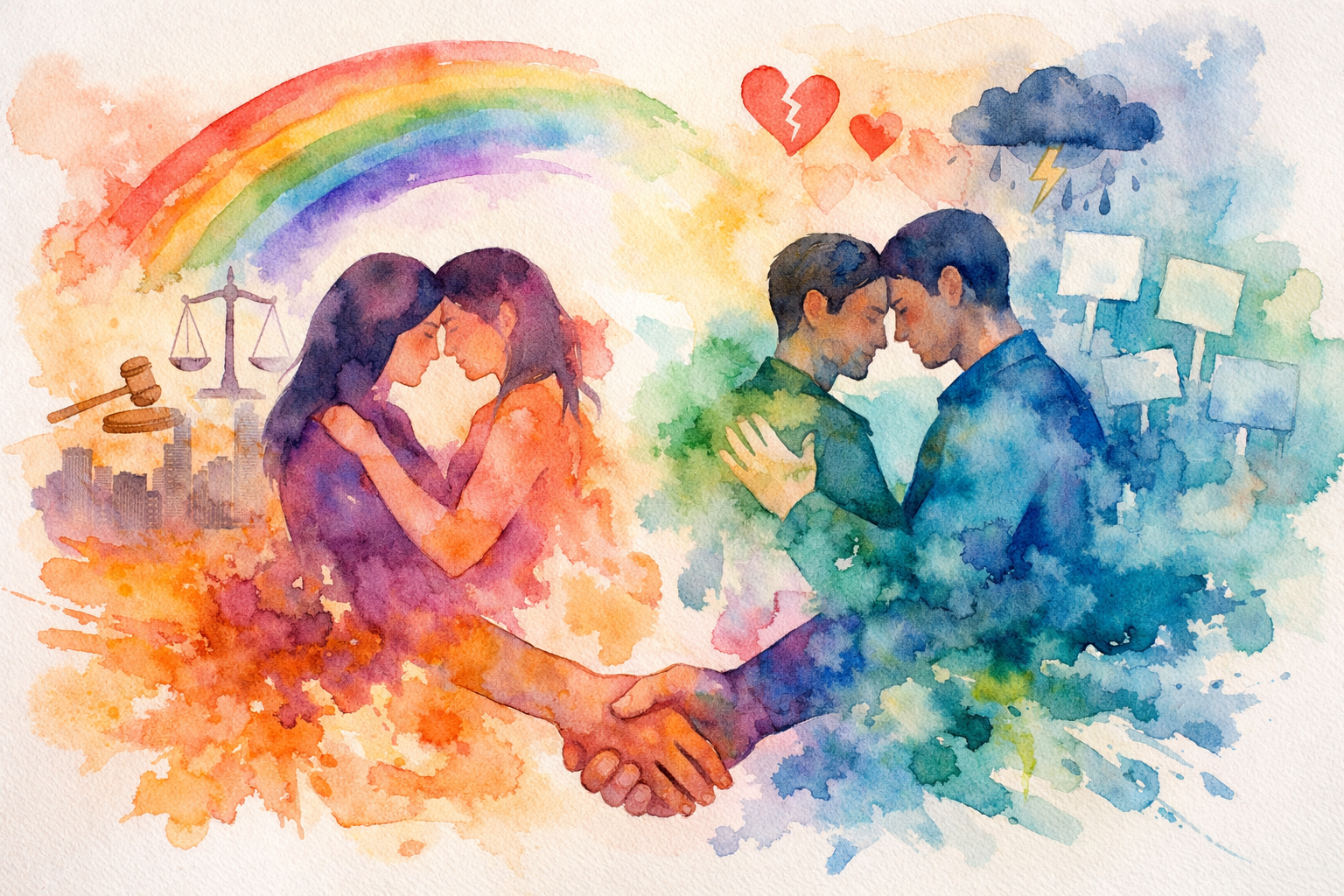

There’s a difference between the stress couples bring into therapy and the stress that surrounds them.
Most couples walk in carrying conflict—communication breakdowns, unmet needs, emotional distance. But for LGBTQ+ couples, there’s often an additional layer that’s harder to name and easier to overlook: stress that doesn’t originate within the relationship, but presses in on it from the outside.
Legal uncertainty. Social stigma. Family rejection. Cultural invisibility.
These forces don’t just affect individuals. They shape how couples relate, how safe they feel, how conflict unfolds, and how connection either strengthens—or erodes—over time.
This is where understanding minority stress becomes essential.
Understanding Minority Stress: The Invisible Third in the Relationship
The concept of minority stress refers to the chronic strain experienced by individuals who belong to stigmatized social groups. For LGBTQ+ individuals, this includes discrimination, fear of rejection, internalized stigma, and ongoing decisions about disclosure and safety.
But in relationships, this stress doesn’t stay contained within one person.
It becomes relational.
Research shows that minority stress operates across multiple levels—individual, interpersonal, institutional, and cultural—and directly impacts the functioning of couples.
This means:
- A hostile law isn’t just political—it becomes emotional strain in the relationship.
- A dismissive family comment doesn’t just hurt one partner—it affects trust, safety, and connection between both.
- A workplace disclosure decision becomes a couple-level negotiation.
In many ways, LGBTQ+ couples are not just managing each other—they’re managing a shared environment that often feels unpredictable or unsafe.
Legal Stress: When Policy Becomes Personal
Legal systems shape relationships in ways that are often invisible—until they’re not.
Even in contexts where LGBTQ+ rights have expanded, research shows that legal recognition alone does not eliminate stress. The perception of unequal recognition—feeling that your relationship is not fully valued—continues to predict worse mental health outcomes.
1. Relationship Legitimacy and Psychological Safety
Legal recognition (such as marriage equality) has been associated with improved mental health and reduced stress among LGBTQ+ individuals.
But here’s the nuance:
- Legal recognition can increase stability
- Yet social attitudes often lag behind legal change
Couples may be legally married but still feel socially invalidated.
That gap creates tension:
- “Are we actually safe?”
- “Do we belong here?”
- “How do others see us?”
This ambiguity can subtly erode emotional security within the relationship.
2. Policy Shifts and Relationship Instability
Research has found that couples living in areas with restrictive policies—such as bans on same-sex marriage—were more likely to experience relationship dissolution.
This isn’t because the couples are less committed.
It’s because:
- Chronic stress reduces emotional bandwidth
- External threats increase internal conflict
- Stability becomes harder to maintain under pressure
Legal environments don’t just shape rights—they shape relational outcomes.
3. The Ongoing Stress of Uncertainty
Even in relatively supportive environments, legal protections can feel fragile.
This creates a background anxiety:
- “Will things change?”
- “What happens if protections are rolled back?”
- “Will we still have the same rights next year?”
This type of stress is subtle but persistent—what clinicians often recognize as chronic anticipatory stress.
And over time, it accumulates.
Social Stress: The Daily Micro-Impacts That Add Up
If legal stress is structural, social stress is relational—and often more immediate.
It shows up in everyday interactions:
- Family responses
- Workplace dynamics
- Community acceptance
- Cultural narratives
And these experiences carry real weight.
1. Family Rejection and Its Relational Ripple Effects
Family acceptance plays a central role in relational stability.
When LGBTQ+ individuals experience rejection, research shows increased stress, emotional strain, and even physiological impacts like sleep disruption.
In relationships, this can lead to:
- Increased reliance on the partner as the sole support system
- Heightened sensitivity to conflict
- Pressure on the relationship to “compensate” for lost family support
This often creates an imbalance:
The relationship becomes both partner and emotional lifeline.
That’s a lot for any relationship to hold.
2. Everyday Discrimination and Emotional Spillover
Discrimination doesn’t stay contained to the moment it occurs.
It follows people home.
Research consistently shows that experiences of prejudice and stigma are linked to worse mental health outcomes, including anxiety, depression, and distress.
In couples, this often translates into:
- Irritability or withdrawal after stressful interactions
- Misattribution (“Why are you being distant?” vs. “What happened today?”)
- Increased conflict around seemingly small issues
What looks like a relationship problem is often stress spillover.
3. Internalized Stigma and Its Impact on Intimacy
One of the most complex aspects of minority stress is internalized stigma—absorbing negative societal messages about one’s identity.
Research shows that internalized stigma is associated with lower relationship quality and satisfaction.
This can show up as:
- Difficulty with vulnerability
- Fear of fully being seen
- Shame in expressing needs or desires
Over time, this creates distance—not because partners don’t care, but because parts of themselves feel unsafe to reveal.
The Dyadic Impact: When Stress Becomes Shared
A critical shift in research is the move from understanding minority stress as an individual experience to recognizing it as a couple-level phenomenon.
Studies show that couple-level minority stress is negatively associated with relationship satisfaction, while effective dyadic coping improves outcomes.
In other words:
It’s not just whether stress exists—it’s how couples handle it together.
1. Stress Synchronization
In many LGBTQ+ relationships, stress becomes synchronized:
- Both partners experience similar external pressures
- Both are navigating identity-related challenges
- Both are managing safety and disclosure
This can create deep empathy—but also shared overwhelm.
2. Conflict Amplification
External stress lowers tolerance for internal conflict.
When emotional resources are depleted:
- Small disagreements escalate more quickly
- Repair becomes harder
- Defensive patterns increase
This doesn’t mean the relationship is weak.
It means the context is heavy.
3. The “Us vs. The World” Dynamic
Many LGBTQ+ couples develop a strong sense of unity in response to external stress.
This can be protective:
- Increased closeness
- Strong shared identity
- Deep mutual support
But it can also create pressure:
- Fear of conflict (“We can’t afford to fight”)
- Avoidance of difficult conversations
- Overdependence on the relationship
Strength and strain often exist side by side.
Intersectionality: When Stress Multiplies
Not all LGBTQ+ experiences are the same.
Intersectionality matters.
When sexual or gender identity intersects with race, culture, religion, or immigration status, stress can compound.
Research on intersectional minority stress shows that overlapping identities increase exposure to discrimination and psychological strain.
For couples, this might look like:
- Navigating cultural expectations alongside LGBTQ+ identity
- Managing multiple layers of stigma
- Experiencing different levels of acceptance within the same relationship
This can create asymmetry:
One partner may face significantly more external stress than the other.
And that imbalance can shape the relationship in profound ways.
Mental Health and Relationship Functioning
The connection between minority stress and mental health is well established.
LGBTQ+ individuals are significantly more likely to experience:
- Depression
- Anxiety
- Substance use
- Suicidal ideation
These outcomes are not inherent to identity—they are linked to chronic exposure to stress, stigma, and discrimination.
And mental health inevitably affects relationships, here’s what I’ve seen working with couples and individuals:
1. Emotional Availability
When someone is managing chronic stress or depression:
- Emotional availability decreases
- Communication becomes harder
- Conflict tolerance lowers
Partners may interpret this as disconnection, when it’s actually depletion.
2. Attachment and Safety
Minority stress can shape attachment patterns:
- Increased fear of rejection
- Hypervigilance to conflict
- Difficulty trusting stability
These patterns don’t emerge in a vacuum—they are adaptive responses to real experiences.
3. Health Disparities and Relationship Stress
Systemic barriers—like discrimination in healthcare—also contribute to broader stress.
LGBTQ+ individuals face disparities in access to care and increased health risks due to systemic factors.
Health stress doesn’t stay individual—it becomes relational:
- Caregiving strain
- Financial stress
- Emotional burden
Resilience: What Actually Protects LGBTQ+ Relationships
The story isn’t just about stress.
It’s also about resilience.
Despite these challenges, many LGBTQ+ relationships are deeply strong, adaptive, and connected.
Research highlights several protective factors.
1. Dyadic Coping
Couples who actively cope together—rather than individually—show better relationship outcomes.
This includes:
- Talking openly about stress
- Supporting each other emotionally
- Problem-solving as a team
2. Relationship as a Buffer
Studies show that being in a supportive relationship can actually reduce the psychological impact of stress, including experiences like bullying and victimization.
In other words:
The relationship itself becomes protective.
3. Meaning-Making and Identity Integration
Many couples develop shared narratives:
- “What we’ve gone through together”
- “What we stand for”
- “How we define our relationship”
This meaning-making process strengthens connection and resilience.
Clinical Implications: What This Means in Therapy
For therapists, understanding legal and social stress isn’t optional—it’s foundational.
Without this lens, it’s easy to misinterpret:
- Stress responses as relationship dysfunction
- Withdrawal as lack of care
- Conflict as incompatibility
When in reality, the relationship is responding to pressure.
1. Externalizing the Stress
One of the most powerful interventions is helping couples recognize:
“The problem isn’t just between you—it’s also what’s happening around you.”
This shifts the dynamic from:
- Partner vs. partner
to - Couple vs. stress
2. Strengthening Dyadic Coping
Helping couples:
- Communicate about stress openly
- Validate each other’s experiences
- Develop shared coping strategies
This directly improves relationship outcomes.
3. Addressing Internalized Stigma
Therapy often involves:
- Naming internalized messages
- Challenging shame
- Rebuilding self-worth
Because intimacy requires safety—not just externally, but internally.
Final Thoughts: Relationships Don’t Exist in a Vacuum
LGBTQ+ relationships are not inherently more fragile or more difficult.
But they are often asked to hold more.
More uncertainty, negotiation, and exposure to external pressure.
And yet, many of these relationships develop a depth, resilience, and intentionality that is profoundly strong.
The goal isn’t to eliminate stress—that’s not realistic.
The goal is to understand it, name it, and learn how to move through it together.
Because when couples can shift from:
“Why are we struggling?”
to
“What are we navigating?”
Everything changes.
If you and your partner feel stuck it doesn’t mean your relationship is failing—it usually means you’ve hit a deeper layer that needs more intentional work. Couples therapy can help you understand the pattern, slow it down, and build a version of your relationship that actually fits both of you. If you’re ready to start that process, reach out to schedule a free consultation and we can talk through what that might look like for your relationship.

Dipesh Patel, MBA, MSW, LCSW, LICSW is a couples therapist specializing in Gottman Method Couples Therapy and emotionally focused therapy. He works with high-achieving professionals, the LGBTQ community, first-generation Americans, and multicultural couples navigating relationship stress and life transitions.
Responses
[…] Without support, these unspoken comparisons can quietly erode connection and intimacy. […]
[…] In those moments, your partner’s repair attempt isn’t meeting this fight; it’s colliding with an old, stacked-up history of harm. […]
[…] The LGBTQ+ community is not monolithic, and depression’s impact can look different depending on identity, community context, and past experiences. Here are some trends I see and that research supports: […]